

WHEN PRESCHOOL PLACEMENT FEELS OVERWHELMING
If your child recently qualified for special education preschool services, you may already feel the pressure building.
You’re hearing new terms like:
PPCD (Preschool Programs for Children with Disabilities)
Inclusion classroom
Self-contained classroom
Least Restrictive Environment
Suddenly, you’re expected to decide where your 3- or 4-year-old will spend their school day.
For many families in Leander, Cedar Park, and surrounding Central Texas communities, this decision feels heavy, especially when your child’s primary need is speech and language support.
If you’re still wondering whether your child’s communication skills are developmentally on track before even thinking about school placement, you may want to read my guide on when to wait or pursue a speech evaluation for toddlers.
Let’s break this down in simple, parent-friendly language so you can make a confident, informed choice.
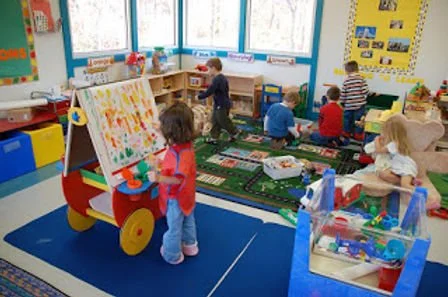
Inclusion preschool classroom in Texas supporting children with speech delays through peer interaction and teacher-guided learning.
First: Understanding Least Restrictive Environment (LRE)
Under special education law (IDEA), schools must educate children in the Least Restrictive Environment (LRE).
In plain terms:
Your child should learn alongside typically developing peers as much as possible, while still receiving the support they need to succeed.
This is why many children with speech delays are first considered for inclusion classrooms before self-contained settings.
Placement exists on a continuum, not a one-size-fits-all model.
Preschool Special Education in Texas (PPCD Explained)
In Texas, special education preschool services are delivered through PPCD- Preschool Programs for Children with Disabilities.
Unlike some states, Texas does not mandate fixed classroom ratios statewide.
Instead:
Class size varies by district (Leander ISD, Round Rock ISD, Austin ISD, etc.)
Staffing is based on student needs
Placement decisions are made by the IEP team
This makes touring classrooms and understanding support levels especially important for families.
Inclusion Preschool Classrooms (Texas PPCD)
Inclusion classrooms, sometimes called Blended PPCD or ECSE Inclusion combine:
Typically developing preschoolers
Children receiving special education services
These classrooms balance peer modeling with embedded support.
Typical Inclusion Ratios in Central Texas
While ratios vary by district, many inclusion PPCD classrooms in the Leander/Cedar Park area look like:
15–18 total students
3–6 students with IEPs
1 certified teacher
1 paraprofessional (sometimes 2)
This creates a language-rich environment with access to peer models.
Communication Supports in Inclusion Settings
Children with speech delays may receive:
Push-in speech therapy
Pull-out speech sessions
AAC device support
Visual schedules
Small-group language instruction
Classroom language modeling
Support is embedded into everyday routines like circle time, centers, and snack.
Understanding whether your child’s challenges relate more to speech sounds or overall language development can also impact placement decisions. You can learn more about the difference between speech and language delays here.
Why Inclusion Can Be Powerful for Speech Development
Peer Modeling
One of the biggest advantages of inclusion is exposure to strong language models.
Children observe peers:
Asking questions
Expanding sentences
Negotiating play
Following directions
Peer modeling often accelerates expressive language growth.
Natural Communication Opportunities
Inclusion classrooms create real reasons to communicate:
Requesting during snack
Problem-solving during play
Participating in songs and routines
Language becomes functional, not forced.
Social Communication Growth
Inclusion supports:
Turn-taking
Joint attention
Cooperative play
Perspective-taking
These skills directly impact long-term communication success.
Self-Contained Preschool Classrooms (Texas PPCD)
Self-contained classrooms serve only students with disabilities who require more intensive support.
Children in these settings may have:
Autism
Global developmental delays
Significant speech/language impairment
Sensory regulation challenges
Medical or mobility needs
These classrooms provide a higher level of scaffolding.
Typical Self-Contained Ratios in Texas
In the Leander/Cedar Park region, self-contained PPCD classrooms often include:
8–12 students
1 special education teacher
1–2 paraprofessionals
Higher-needs classrooms may run smaller (6–8 students).
Communication Supports in Self-Contained Settings
Supports may include:
Embedded speech therapy throughout the day
High AAC usage
Visual communication systems
Sensory regulation supports
Behavior intervention plans
Slower instructional pacing
This environment reduces overwhelm and increases individualized support.
Inclusion vs. Self-Contained: How to Decide
There is no universally “better” placement, only best fit.
Inclusion May Be a Good Fit If Your Child:
Has a primary speech delay
Imitates peers
Demonstrates emerging play skills
Tolerates group routines
Follows simple directions
Benefits from peer modeling
Self-Contained May Be Considered If Your Child:
Is minimally verbal
Requires intensive AAC support
Has significant sensory needs
Becomes overwhelmed in large groups
Needs frequent adult prompting
Has multiple developmental needs
Questions to Ask When Touring PPCD Classrooms
Touring local programs in Leander ISD, Cedar Park, or nearby districts is one of the most important steps you can take.
Here are key questions to guide your visit:
Classroom Structure
How many students are in the class?
How many have IEPs?
How many adults are present full-time?
Speech Therapy Services
Is speech therapy push-in or pull-out?
How often are sessions provided?
Are services individual or group?
AAC & Communication Supports
Are AAC devices modeled by staff?
Are visual supports used daily?
How is communication encouraged during play?
Peer Interaction
How are peer interactions facilitated?
Are there structured play opportunities?
Do students eat and play together?
Sensory & Regulation Support
How are sensory needs supported?
Is OT available?
What happens if a child becomes overwhelmed?
Important Reminder: Placement Can Change
Preschool placement is not permanent.
IEP teams review progress regularly.
If a setting becomes:
Too restrictive
Not supportive enough
Missing communication growth
Changes can be made.
Your child’s placement should evolve as their skills grow.
How Parent Coaching Supports Preschool Placement Decisions
Many families in Leander and Cedar Park seek guidance navigating PPCD placement.
Parent coaching can help you:
Understand evaluation results
Prepare for IEP meetings
Advocate for speech therapy frequency
Determine inclusion readiness
Identify appropriate communication supports
You don’t have to navigate the system alone.
Final Thoughts
Choosing between inclusion and self-contained preschool isn’t about picking the “best” classroom.
It’s about finding the environment where your child can:
Communicate
Participate
Feel regulated
Build relationships
Make meaningful progress
When placement matches support needs, children thrive.
Frequently Asked Questions
What is the difference between inclusion and self-contained classrooms?
An inclusion classroom places a child with disabilities in a general education setting with typically developing peers, often with support services provided within the classroom.
A self-contained classroom is a specialized setting designed for students who need more individualized instruction, smaller group learning, and higher levels of support throughout the school day.
Is inclusion always better than self-contained placement?
Not always. Inclusion can offer strong peer language models and social opportunities, but some children benefit from the structure, pace, and individualized support of a self-contained classroom. The most appropriate placement depends on a child’s communication, learning, sensory, and behavioral needs.
How is classroom placement decided in an IEP?
Placement decisions are made by the ARD/IEP team, which includes parents, educators, and specialists. Federal law requires that children be educated in the least restrictive environment (LRE) appropriate for their needs, meaning the setting where they can learn best with necessary supports.
Can my child move from self-contained to inclusion later?
Yes. Classroom placement is not permanent. As children make progress academically, socially, or communicatively, the IEP team can adjust placement to increase time in general education settings.
Will my child still receive speech therapy in both settings?
Yes. Speech therapy is provided based on IEP eligibility and service minutes not classroom type. Services may occur in the classroom (push-in) or in a therapy space (pull-out), depending on goals and needs.
Does inclusion help speech and language development?
For many children, inclusion provides access to peer language models, social communication opportunities, and naturalistic language exposure. However, children with more complex communication needs may require structured teaching first before generalizing skills in inclusion settings.
What are signs a self-contained classroom may be appropriate?
Some indicators include:
Significant language delays
Limited functional communication
Difficulty accessing general education curriculum
High sensory or behavioral support needs
Need for individualized pacing or instruction
Placement decisions should always be individualized.
Can parents disagree with the school’s placement recommendation?
Yes. Parents are equal members of the IEP team and can ask questions, request data, seek outside evaluations, or request another ARD meeting if they feel a different placement would better support their child.
Is one placement more “restrictive” than the other?
Self-contained classrooms are considered more restrictive because they involve less time with general education peers. However, “restrictive” does not mean “bad.” It simply refers to the level of specialized support provided.
Can private speech therapy support my child regardless of school placement?
Yes. Many families pursue private speech therapy alongside school services to provide more individualized, intensive, or home-based support, especially during transitions between classroom settings.
If you would like individualized guidance about your child’s communication needs before your next ARD meeting, you can learn more about my comprehensive speech evaluations and parent consultations here.
Need help preparing for your child’s PPCD placement or IEP meeting?
Written by Sonia Chowdhury Lopez, MS, CCC-SLP
Owner and Speech-Language Pathologist at Speechie Auntie
