

Understanding the Difference Between Having Words and Using Language Meaningfully
“He knows all his colors!”
“She can count to 20!”
“He can name every animal in his favorite book!”
“But, when he wants something, he just cries or pulls me toward it.”
Does this sound familiar?
As a pediatric speech-language pathologist, I often meet families who are confused because their toddler can say plenty of words but struggles to use those same words to communicate their wants, needs, thoughts, and feelings.
Parents may wonder how their child can identify every letter of the alphabet but struggle to ask for a drink of water.
The answer lies in an important distinction: Knowing words and using words to communicate are not necessarily the same skill.
Let's explore what this means for your child's language development.
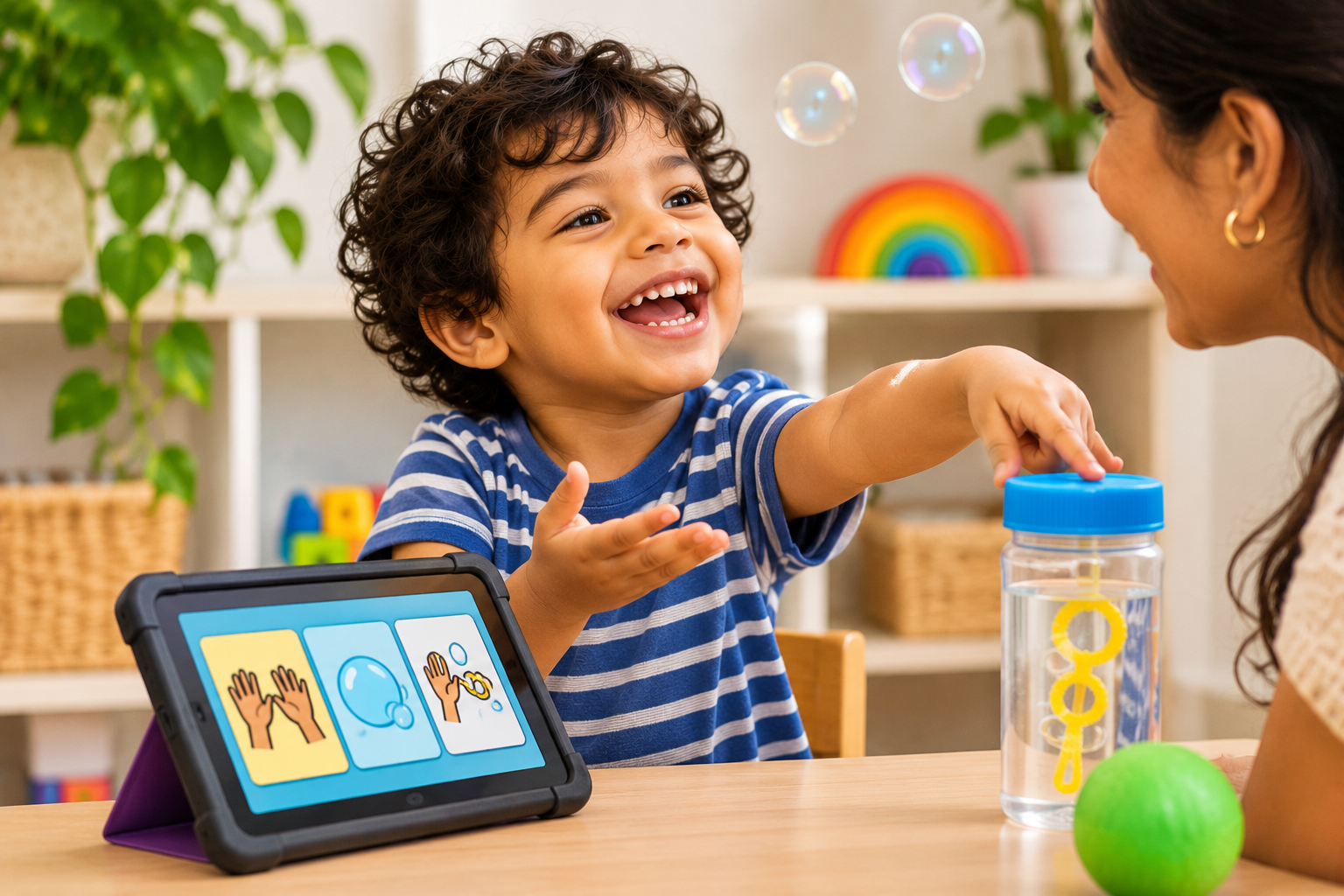
Knowing Words vs. Using Words: What's the Difference?
Imagine a toddler who can name 20 different animals when looking at pictures.
You point to a picture of a cow, and they enthusiastically say, “Cow!”
You show them a dog, and they respond, “Dog!”
You ask them what color the ball is, and they correctly answer, “Blue!”
These are wonderful emerging vocabulary skills.
What happens when that same toddler needs help opening a container?
Do they say “help,” gesture toward the container, or find another way to communicate their need?
What happens when they want another turn on the swing?
Can they request “more,” say “again,” gesture, or communicate their desire in another meaningful way?
This is where we begin looking beyond vocabulary and examining functional communication.
Parents often confuse speech and language development, but they involve different skills. Understanding the difference between speech and language delays can help you better recognize your child's communication strengths and needs.
What Is Functional Communication?
Functional communication refers to a child's ability to communicate meaningful messages for real purposes throughout everyday life.
Here's something important: Functional communication is not limited to spoken words.
Children can communicate through:
Spoken words and phrases
Gestures and pointing
Facial expressions
Signs
Augmentative and alternative communication (AAC)
Body movements and other intentional communication behaviors
The goal is not simply to increase the number of words a child can say.
The goal is to help children communicate their own messages in ways that others can understand.
Communication doesn't have to be spoken to be meaningful. For children who benefit from additional communication supports, AAC is not a last resort. It can provide another way for children to express themselves, participate in everyday interactions, and connect with others.
Communication Is More Than Requesting
When parents think about communication, they often think about asking for things.
“Milk.”
“More.”
“Open.”
“Help.”
While requesting is an important communication function, children communicate for many other reasons.
They communicate to:
Protest: “No!” or “Stop!”
Comment: “Big truck!”
Share excitement: “Wow! Look!”
Ask questions: “Where Daddy?”
Express feelings: “I'm scared.”
Get attention: “Mommy, watch!”
Participate socially: “Hi!” or “Your turn!”
Share information: “Doggy sleeping.”
A child may have a large vocabulary but still need support learning how to use language across these different communication functions.
Why Can My Toddler Label Everything but Not Ask for What They Want?
There isn't one simple explanation.
Some children develop strong labeling skills because they've had many opportunities to practice naming familiar objects.
Think about how frequently adults ask young children:
“What color is this?”
“What animal is that?”
“What does the cow say?”
These interactions can help children learn vocabulary.
However, answering a familiar question is different from independently deciding to communicate a message.
For example, a child might say “apple” when an adult points to a picture but not spontaneously use that word when they see an apple they want to eat.
The difference involves several language skills, including initiating communication, retrieving vocabulary, understanding how words function in different contexts, and using language flexibly.
Other children may use memorized words or phrases, have difficulty planning speech movements, or demonstrate differences in social communication.
A comprehensive speech-language evaluation helps identify each child's unique strengths and needs rather than assuming that every child who labels objects but rarely requests has the same underlying difficulty.
What About Toddlers Who Repeat Everything They Hear?
Some toddlers are excellent at repeating words and phrases.
You say, “Say banana,” and they immediately respond, “Banana!”
You say, “I want juice,” and they repeat, “I want juice!”
Later, when they're thirsty, they may not independently use that same phrase.
This is another example of why imitation and spontaneous communication are different skills.
Repeating language can be an important part of development, and repetition may itself serve a meaningful communicative purpose.
Some children also use echolalia, repeating words or phrases they've heard previously. These phrases may communicate excitement, requests, protests, or other meaningful messages.
Rather than dismissing repeated language as meaningless, we should consider the context and what the child may be trying to communicate.
The goal is to understand how the child currently communicates and support greater flexibility and independence.
If your toddler frequently repeats phrases from favorite shows, books, or conversations, you may also find my article about why toddlers repeat phrases from TV shows, movies, and books helpful.
Five Ways to Support Functional Communication at Home
The good news is that you don't need flashcards, expensive toys, or structured drills to create meaningful communication opportunities.
Everyday interactions offer countless opportunities to support language development.
1. Model Language Instead of Constantly Asking Questions
Instead of repeatedly asking, “What's this?” while playing with toy cars, try modeling meaningful phrases.
“Car goes fast!”
“Uh-oh! It crashed!”
“Let's go again!”
This exposes your child to language they can use during actual experiences rather than only practicing labels.
2. Follow Your Child's Interests
If your toddler loves bubbles, join them!
You might model:
“Bubbles!”
“More bubbles!”
“Pop!”
“Big bubble!”
“Again!”
Following your child's interests creates natural opportunities for communication because the activity is already meaningful to them.
Play provides natural opportunities for children to communicate, share experiences, and build relationships. In my article, Why Play Is the Foundation of Communication Development, I explore why meaningful, child-led interactions are so important for early language development.
3. Create Opportunities for Different Communication Functions
Think beyond asking your child to request more.
During play, model commenting, protesting, asking for help, and sharing excitement.
For example, while building a block tower:
“It's so tall!”
“Uh-oh!”
“Don't knock it down!”
“Help me!”
“Let's build again!”
These simple interactions expose children to the many reasons we communicate.
4. Respond to All Forms of Communication
If your child points toward a toy, acknowledge their message.
“You want the truck!”
If they push something away, you might say:
“No more. You're all done.”
By responding to gestures, facial expressions, AAC, and spoken language, we reinforce that communication has meaning and that their messages matter.
You can model spoken words without requiring your child to imitate them before responding.
5. Give Your Child Time to Communicate
Sometimes adults are so quick to anticipate children's needs that we unintentionally limit opportunities for children to initiate communication.
During familiar activities, try pausing briefly and observing.
Your child may look toward you, gesture, vocalize, use AAC, or say a word.
Respond to their attempt and build on it naturally.
The goal is to create opportunities for communication, not to withhold desired items or pressure your child to speak.
When Should Parents Consider a Speech-Language Evaluation?
If your toddler can name objects, repeat words, or recite familiar sequences but has difficulty communicating independently, a comprehensive speech-language evaluation may be helpful.
Consider seeking guidance if your child:
Rarely initiates communication
Primarily labels objects but has difficulty using language for other purposes
Repeats words or phrases but struggles to use them flexibly
Has difficulty communicating wants, needs, or feelings
Relies heavily on adults anticipating their needs
Demonstrates frustration when communication breaks down
Has difficulty using communication skills across different settings
These observations do not automatically indicate a language disorder.
Children develop differently, and communication profiles vary considerably.
A qualified pediatric speech-language pathologist can evaluate receptive language, expressive language, social communication, play skills, speech production, and other relevant areas to determine whether additional support would be beneficial.
The Bottom Line: Communication Is About Connection, Not Just Words
As a pediatric speech-language pathologist, I want parents to understand that language development isn't simply about how many words a child knows.
It's about what children can do with those words.
Can they share their excitement?
Can they tell you when something is wrong?
Can they ask for help?
Can they express their preferences?
Can they connect with the people around them?
More importantly, can they communicate these messages in whatever way is accessible to them?
A child's communication abilities should never be measured by spoken vocabulary alone.
Our goal is to support meaningful, independent, and authentic communication while respecting each child's individual developmental journey.
Looking for Pediatric Speech Therapy in Leander or Cedar Park, TX?
At Speechie Auntie, PLLC, I provide individualized, play-based pediatric speech-language evaluations, in-home therapy, and caregiver coaching for toddlers and preschoolers in Leander, Cedar Park, and surrounding Central Texas communities.
My approach focuses on understanding the whole child, building meaningful connections, and helping families support communication naturally during everyday routines.
If your toddler knows plenty of words but struggles to use them to communicate, I'd love to help you better understand their communication development.
Written by Sonia Chowdhury Lopez, M.S., CCC-SLP
Owner and Speech-Language Pathologist at Speechie Auntie
