

TWO TYPES OF LANGUAGE DEVELOPMENT: ANALYTIC LANGUAGE DEVELOPMENT AND GESTALT LANGUAGE DEVELOPMENT
Analytic and gestalt language development are two different ways children can develop language. Both styles of language development are natural pathways to language acquisition. There are some key differences between the two that are helpful to understand in order to support your child’s language development effectively.
Many families first start researching language development when they notice their toddler isn’t talking as expected. If you’re unsure whether your child’s communication is on track, you can read more about early signs of speech delay in toddlers here.

Language grows through connection, play, and shared routines
WHAT IS AN ANALYTIC LANGUAGE PROCESSOR (ALP)?
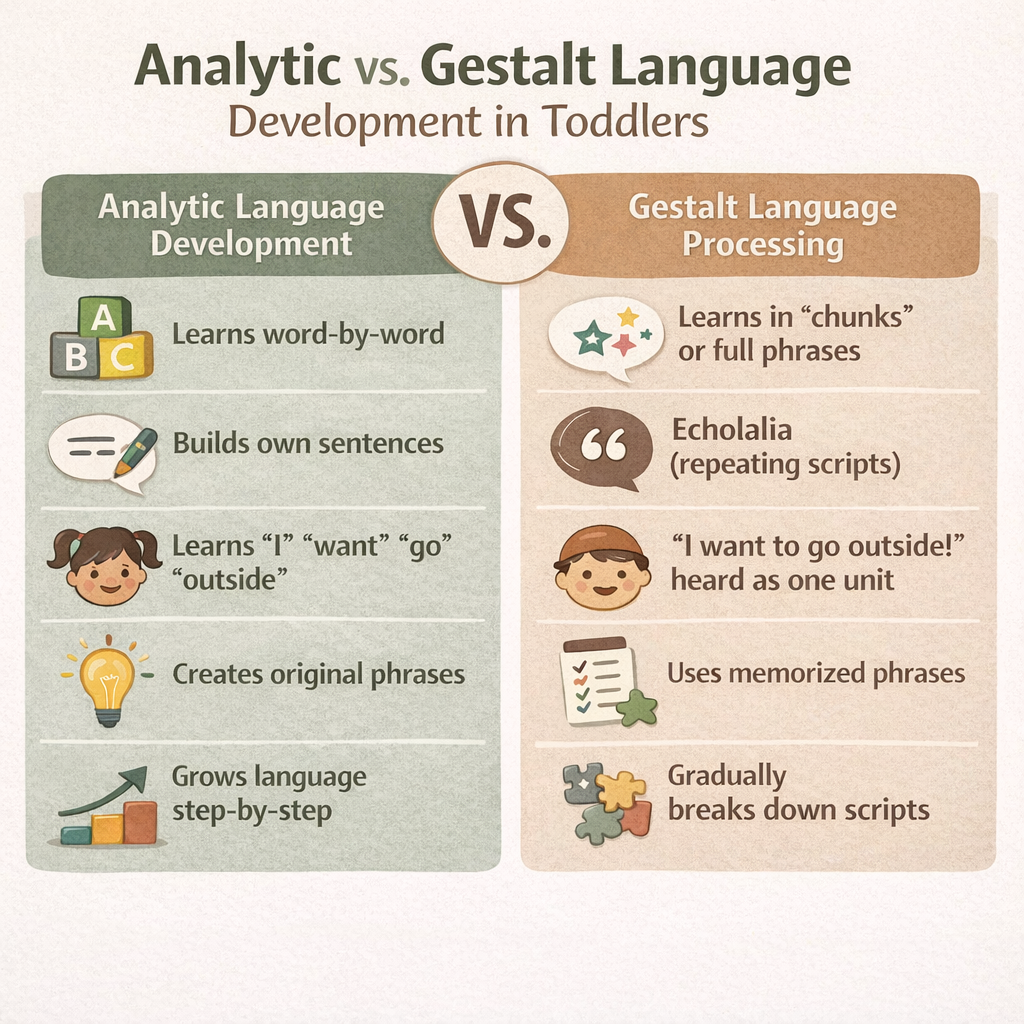
An analytic language processor is a child who learns language through single units, where one word represents meaning. As they continue to develop language, they add more words to produce a phrase, sentence, and then conversation.
There are four stages to analytic language development:
Stage 1: Single Words
Example: “Block”
Stage 2: Two-Word Combinations
Example: “Blue block”
Stage 3: Phrases
Example: “Want blue block”
Stage 4: Sentences
Example: “I put the blue block on top of the yellow block”
WHAT IS A GESTALT LANGUAGE PROCESSOR (GLP)?
A gestalt language processor is a child who learns language by memorizing whole phrases or “gestalts” (i.e., echolalic utterances which hold meaning for the child). As they continue to develop language, they break down those scripts into individual words and eventually recombine words to produce self-generated utterances.
There are six stages to gestalt language development:
Stage 1: Delayed Echolalia
Example: “Just keep swimming”
Stage 2: Mitigated Gestalts
Example: “Just keep jumping”
Stage 3: Single Words & Two-Word Combinations
Example: “Swimming”
Stage 4: Beginning Grammar
Example: “The swimming pool people”
Stage 5: More Advanced Grammar
Example: “The swimming pool is busy”
Stage 6: Complex Grammar
Example: “Due to the holiday, the swimming pool is very crowded today”
Signs Your Child May Be a Gestalt Language Processor
Four common signs that a child is a gestalt language processor:
1. Long Gestalts- Gestalt language processors will use long chunks of language known as scripts. Children will repeat chunks of language they heard in or out of context from songs, videos, TV shows, or movies.
2. Single Words- Gestalt language processors are able to name many items using single words and may respond to some questions with single words. These single words become stuck, and the child is unable to combine these words to produce expanded utterances.
3. Rich Intonation- Gestalt language processors are often called ‘intonation babies’ because they enjoy animated speech used by others and tend to use the same rhythm and tone of this animated speech.
4. Unintelligible Long Strings of Language- Gestalt language processors will use long, unintelligible strings of language that sound like gibberish. You may recognize these strings of language resemble intonation from songs, videos, TV shows, or movies the child enjoys.
If you’re noticing scripting, echolalia, or delayed conversational language, it may be helpful to explore whether a speech and language evaluation is appropriate. This guide walks families through what to expect during the toddler evaluation process.
Understanding Analytic vs. Gestalt Language Development
The chart below highlights key differences between analytic and gestalt language development pathways.
How Speech Therapy Supports Both Language Styles
Speech therapy looks different depending on whether a child is an analytic or gestalt language learner. Parent coaching is often a key component, helping families learn how to model flexible language during daily routines.
Find a speech language pathologist who specializes in analytic and gestalt language development. They will be able to assess your child to help determine how they process language, and at which stage they’re currently functioning in. Be sure to find a speech therapist well versed in both styles of language development so that your child is appropriately supported as they transition between the stages. Play-based speech therapy is often used to support gestalt learners.
Speech Therapy Support in Leander & Cedar Park
Families in Leander, Cedar Park, and North Austin often hear terms like “gestalt language processing” during evaluations but aren’t always sure what it means for their child’s development. Understanding your child’s language learning style helps guide therapy, home strategies, and expectations for progress.
FREQUENTLY ASKED QUESTIONS
Do gestalt language processors speak later?
Not necessarily. They develop language differently, often using scripts before generating original phrases.
Is gestalt language processing autism?
No. While common in autistic children, gestalt processing can occur in other developmental profiles.
Can speech therapy help gestalt language learners?
Yes. Therapy focuses on modeling flexible language, breaking down scripts, and supporting self-generated speech.
If you’re trying to understand your child’s language learning style or wondering whether therapy could help, Speechie Auntie offers in-home speech therapy and parent coaching for toddlers and preschoolers in Leander, Cedar Park, and surrounding areas. You can contact us here to get started.
