

How to Help Your Toddler Talk: 5 Everyday Speech Therapy Activities at Home
If you've been searching for speech therapy activities at home or wondering, "How can I help my toddler talk?" you're not alone.
Many parents become concerned when their toddler isn't talking as much as expected. They begin searching online for toddler language activities, speech delay activities, or ways to support language development at home. With so much information available, it's easy to feel overwhelmed.
Here's the good news: you don't need flashcards, worksheets, expensive toys, or educational apps to help your child learn to communicate.
Young children learn language through meaningful interactions with the people they love. Everyday routines like eating breakfast, taking a bath, reading books, grocery shopping, and playing together create hundreds of natural opportunities for communication every single week.
Whether your child has a speech delay, autism, is a late talker, or simply needs extra support developing communication skills, these ordinary moments often become the most powerful learning opportunities.
As a pediatric speech-language pathologist and owner of Speechie Auntie, I spend much of my time coaching families throughout Leander, Cedar Park, Liberty Hill, Georgetown, Round Rock, Pflugerville, North Austin, and surrounding Central Texas communities on how to turn everyday routines into meaningful language-learning experiences. Communication doesn't only happen during speech therapy sessions, it happens all day long.
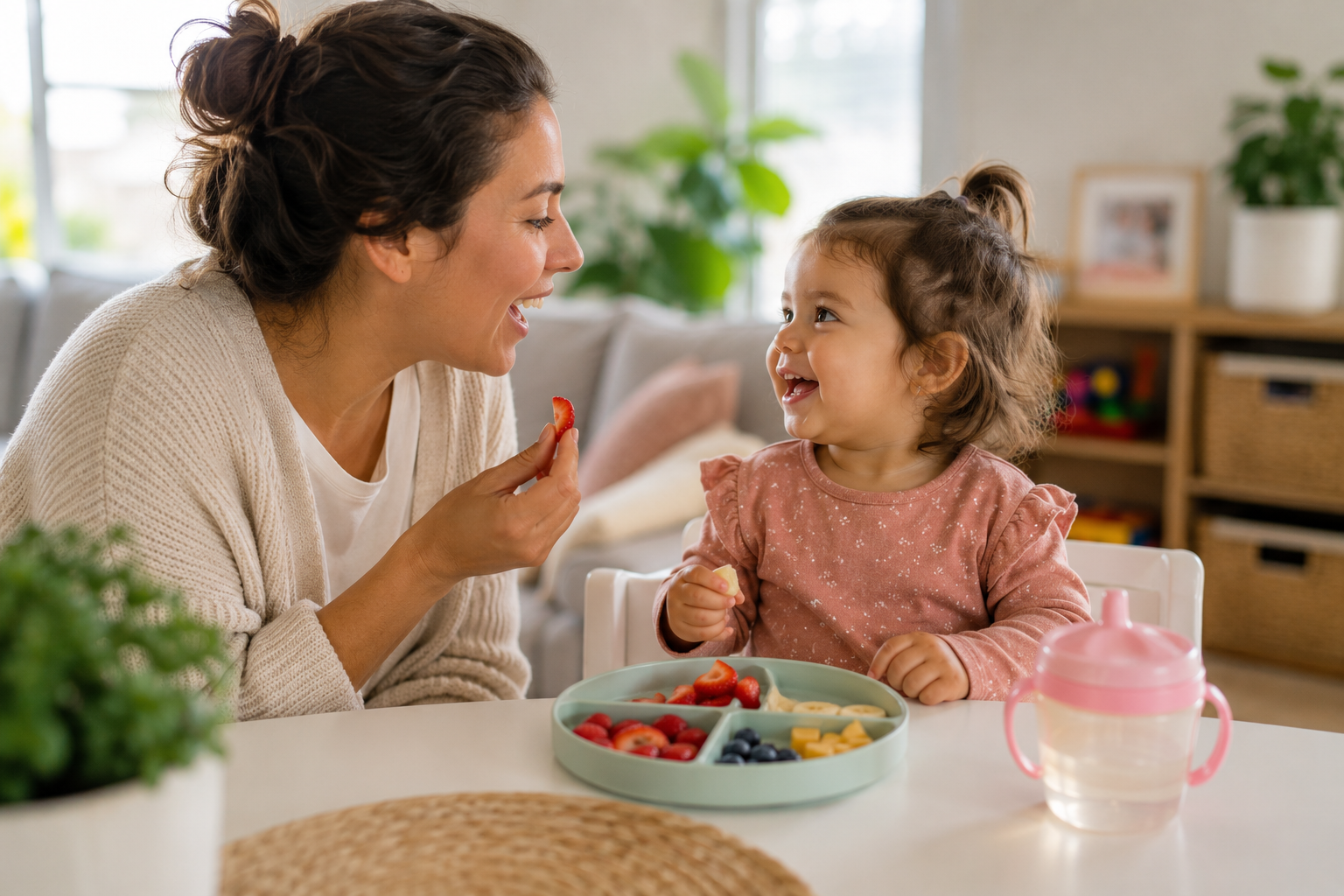
You don't need extra time or special materials to help your toddler learn to talk. Everyday routines like mealtime are filled with opportunities for meaningful communication.
Here are five everyday routines that naturally encourage communication without requiring expensive materials, extra preparation, or flashcards.
1. Mealtime: One of the Best Speech Therapy Activities at Home
Meals naturally create opportunities for children to communicate because they're motivated to ask for favorite foods, request more, make comments, and participate in family conversations.
Instead of asking your child a series of questions like, "What color is your cup?" or "What's this called?" try making simple comments about what they're already experiencing.
For example:
"You got strawberries!"
"Crunch, crunch."
"Cold milk."
"More grapes."
"Uh oh...all gone!"
"Yummy!"
"That's a BIG bite."
One of my favorite strategies is to hold back one item for just a few seconds before handing it to your child. That brief pause gives them an opportunity to communicate.
Your child may communicate by:
Looking at you
Pointing
Reaching
Making a sound
Using a gesture
Signing
Using their AAC device
Saying a word or phrase
Every one of those communication attempts matters.
Why It Works
Children are highly motivated during meals, making them more likely to communicate. Mealtime naturally encourages requesting, commenting, turn-taking, and vocabulary development without feeling like work.
Speechie Auntie Tip: Instead of trying to get your child to label every food, simply enjoy the conversation together. Communication is much bigger than naming pictures or answering questions correctly.
2. Bath Time Builds Language Development at Home
Bath time is one of my favorite toddler language activities because it happens almost every day, follows a predictable routine, and is usually full of laughter and play.
You don't need bath toys that "teach language." You simply need to talk about what's happening.
Model words like:
Wet
Dry
Splash
Wash
Bubbles
Pour
In
Out
More
Empty
Full
Clean
Dirty
Hot
Cold
Instead of giving constant directions, try narrating what your child is doing.
"You poured the water."
"Big splash!"
"The bubbles are all gone."
"Oh! Your duck is floating!"
Repeat these same words each bath. Children learn language through repetition across meaningful experiences.
Why It Works
Bath time provides repeated opportunities to hear and experience the same vocabulary in context. Predictable routines help toddlers understand new words and eventually begin using them independently.
Speechie Auntie Tip: Don't worry about introducing lots of new words every bath. Repeating the same simple vocabulary over and over helps your child understand and eventually use those words independently.
3. Reading Books Together Helps Toddlers Learn to Talk
Reading together is one of the most powerful ways to support language development at home, but it doesn't have to look like a quiz.
Many parents feel pressure to ask questions throughout every page.
"What color is that?"
"What's this?"
"What does the dog say?"
While there's certainly a place for questions, conversations build language much more effectively than constant testing.
Instead, make comments.
"I see a BIG dog."
"He's running!"
"Oh no! He fell."
"That bear looks sleepy."
"I wonder what's going to happen next."
Then pause.
Give your child time to look, point, laugh, make a sound, finish your sentence, or tell you what they notice.
If your child wants to skip pages, read the same page repeatedly, or focus on one picture, that's okay. Follow their lead. The goal isn't finishing the book, it's enjoying communication together.
Many of the families I work with throughout Leander and surrounding Central Texas communities are surprised to learn that the best speech therapy activities at home don't require special materials, just intentional interactions during everyday routines.
Why It Works
Books expose children to vocabulary they may not hear during everyday conversation while creating opportunities for shared attention, commenting, predicting, and storytelling. Research consistently shows that children learn language best through responsive interactions with caring adults.
Speechie Auntie Tip: Reading the same favorite book over and over again isn't "boring." Repetition is one of the best ways young children learn new words and sentence structures.
4. Getting Dressed Encourages Everyday Communication
Getting dressed might not feel exciting, but it's filled with opportunities to build language.
Talk about what you're doing as you help your child get ready.
Try modeling words like:
Shirt
Pants
Socks
Shoes
Hat
On
Off
Up
Down
Help
Stuck
Zip
Button
Open
Close
If your child reaches toward you while holding a shirt, they're already communicating.
Respond to that communication.
"You need help!"
"Let's put your shirt ON."
"Sock OFF!"
You don't need to wait for spoken words before responding. Gestures, eye contact, body movements, signs, and AAC messages are all meaningful forms of communication.
Why It Works
Daily dressing routines expose children to action words, clothing vocabulary, and early concepts like on/off, in/out, and up/down. Since these routines happen every day, children receive hundreds of natural learning opportunities over time.
Speechie Auntie Tip: Slow down just a little. Holding up a shoe or shirt and waiting a few seconds before helping often gives your child an opportunity to communicate in their own way, whether that's a look, a gesture, a sign, an AAC message, or a word.
5. Snack Time Creates Natural Opportunities for Speech
Snack time is another excellent speech therapy activity at home because favorite foods naturally motivate communication.
Instead of placing the entire bag of crackers or fruit snacks in front of your child, keep it nearby.
Offer one or two pieces.
Pause.
Wait expectantly.
See what your child does.
That small pause creates an opportunity for them to communicate before their needs are automatically met.
Maybe they reach toward the container.
Maybe they look at you.
Maybe they vocalize.
Maybe they sign "more."
Maybe they press "more" on their AAC device.
Maybe they say, "More crackers!"
Every communication attempt deserves a response.
Children quickly learn that communication has power when they see it helps them get their wants and needs met.
Why It Works
Motivation is one of the strongest drivers of communication. Favorite snacks encourage children to request, comment, protest, make choices, and engage in back-and-forth interactions with familiar adults.
Speechie Auntie Tip: A pause doesn't mean withholding or frustrating your child. Think of it as creating space for communication. If they don't communicate after waiting a few seconds, simply model the language yourself ("More crackers!") and then happily give them the snack.
You Don't Need to Add More to Your Day
One of the biggest misconceptions about helping a child with speech and language development is that parents need to carve out extra time for structured lessons or purchase special materials.
The truth is, some of the best speech therapy activities at home happen during routines you're already doing every day. Whether you're sharing a meal, reading a favorite book, getting dressed, taking a bath, or enjoying a snack together, these everyday moments are full of opportunities to build your child's communication skills.
The goal isn't to make every interaction feel like therapy. Instead, focus on being present, following your child's lead, modeling simple language, and pausing to give them opportunities to communicate in whatever way works best for them, whether that's through words, gestures, signs, facial expressions, or an AAC device.
Remember, language develops through thousands of meaningful interactions over time. Those small moments may seem ordinary, but together they lay the foundation for lifelong communication.
How Speechie Auntie Can Help
If you're concerned about your child's speech or language development, you don't have to figure it out alone.
At Speechie Auntie, I provide in-home pediatric speech therapy and individualized caregiver coaching throughout Leander, Cedar Park, Liberty Hill, Georgetown, Round Rock, Pflugerville, North Austin, and surrounding Central Texas communities. Together, we'll create practical, evidence-based strategies that fit naturally into your family's everyday routines, helping your child build communication skills where they matter most, at home and in daily life.
Whether your child has a speech delay, autism, is a late talker, is learning more than one language, or uses AAC, my goal is to help your family feel confident supporting communication beyond our therapy sessions.
Frequently Asked Questions
How can I help my toddler talk at home?
The best way to help your toddler talk is by creating opportunities for communication during everyday routines. Instead of relying on flashcards or worksheets, talk about what your child is doing, follow their interests, model short phrases, and pause to give them time to communicate. Everyday activities like mealtime, bath time, reading books, and getting dressed provide countless opportunities to support language development at home.
What are the best speech therapy activities at home?
Some of the best speech therapy activities at home don't require any special materials. Everyday routines like mealtime, snack time, bath time, reading books, and getting dressed naturally encourage children to request, comment, ask for help, and learn new vocabulary. The key is to make communication a part of your daily interactions rather than setting aside time for formal lessons.
Are flashcards helpful for speech delay?
Flashcards can be useful for teaching specific vocabulary or concepts in some situations, but they are not the primary way most toddlers learn language. Young children learn best through meaningful interactions with caring adults during real-life experiences. Talking, playing, reading together, and following your child's interests are often far more effective for building communication skills than memorizing pictures on flashcards.
Does my toddler need speech therapy?
Every child develops at their own pace, but if you're concerned about your toddler's communication skills, it's always okay to ask questions. A speech-language evaluation can help determine whether your child's communication is developing as expected or whether additional support may be beneficial. Early intervention can make a meaningful difference, and seeking an evaluation doesn't automatically mean your child will need ongoing therapy.
What if my toddler doesn't talk during these activities?
That's okay! Communication is much more than spoken words. Your child may communicate by looking at you, pointing, reaching, using gestures, making sounds, signing, or using an AAC device. Responding to all forms of communication helps children learn that their attempts to connect with others are meaningful and effective. Over time, these everyday interactions help build the foundation for spoken language and other communication skills.
If you've been wondering how to help your toddler talk, I'd love to help. Contact Speechie Auntie today to schedule a comprehensive speech and language evaluation and let's build your child's communication skills, one everyday routine at a time.
Written by Sonia Chowdhury Lopez, M.S., CCC-SLP
Owner and Speech-Language Pathologist at Speechie Auntie
