

5 More Everyday Activities at Home That Help Your Toddler Learn to Talk Naturally
If you haven't already, be sure to check out my first blog, 5 Everyday Speech Therapy Activities at Home That Build Your Toddler's Language, for even more simple ways to encourage communication during your everyday routines.
When parents think about helping their toddler learn to talk, they often imagine flashcards, educational apps, or expensive learning toys. However, the truth is, some of the best speech and language opportunities happen during the ordinary moments you already share together.
As a pediatric Speech-Language Pathologist and owner of Speechie Auntie, PLLC, serving families throughout Leander, Cedar Park, Liberty Hill, Georgetown, Round Rock, Pflugerville, and North Austin, one of my favorite things to teach parents is how to turn everyday routines into meaningful opportunities for building speech and language skills.
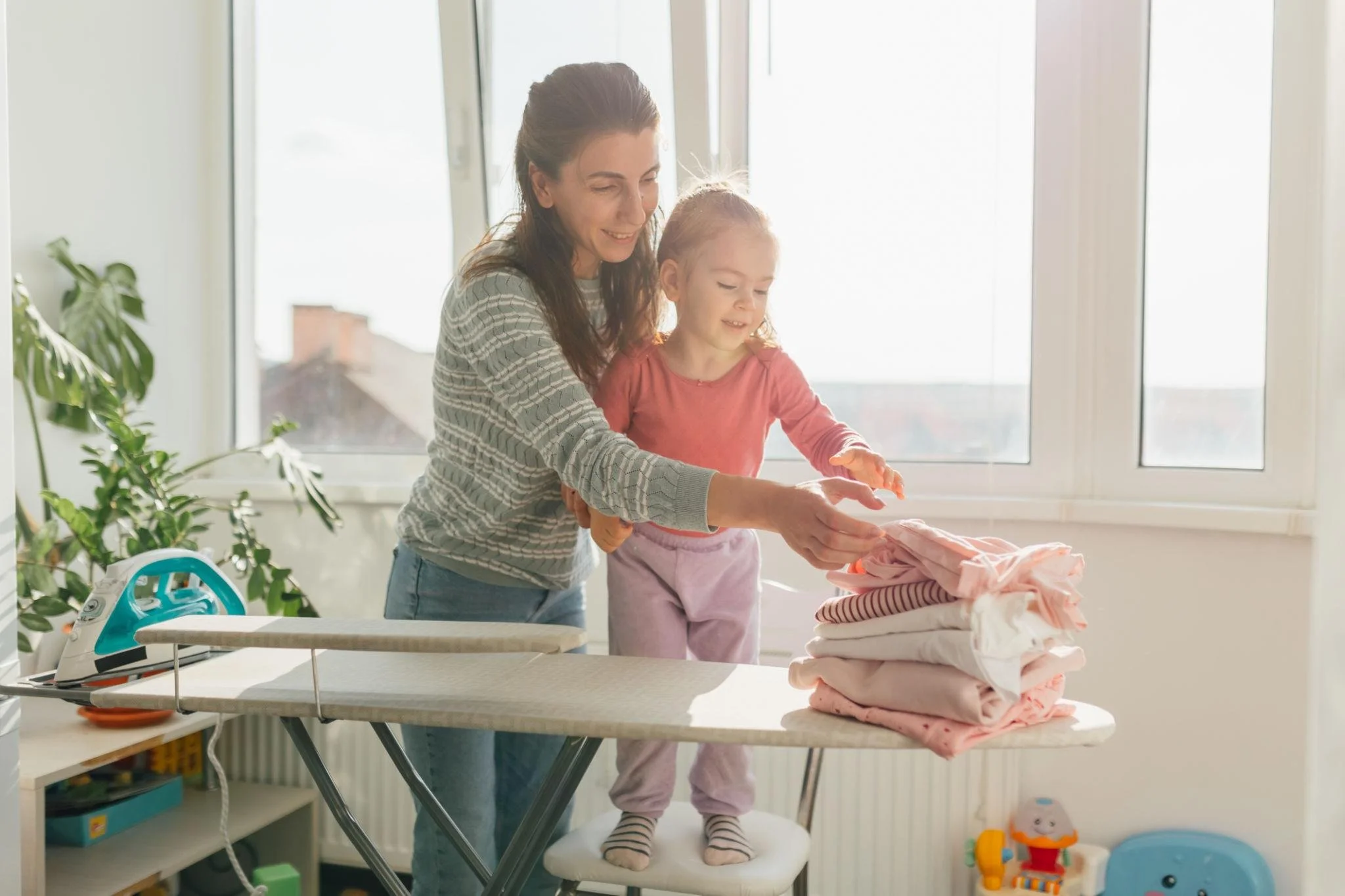
Everyday routines like folding laundry create natural opportunities to build your toddler's speech and language skills.
I encourage the families I work with throughout Leander, Cedar Park, Liberty Hill, Georgetown, Round Rock, Pflugerville, and North Austin to look for these small opportunities every day. They add up to hundreds of meaningful language-learning moments every week.
Why Everyday Routines Are So Important for Language Development
One of the biggest misconceptions I hear from parents is that language learning only happens during structured teaching activities.
In reality, toddlers learn language best when words are connected to meaningful experiences.
When your child helps fold laundry, splashes in the bathtub, watches birds outside the window, or stirs pancake batter, they're hearing words that immediately match what they're seeing, feeling, and doing.
That's exactly how vocabulary grows.
These short moments happen dozens of times every day, making them some of the most powerful speech therapy activities you can do at home.
Let's dive into five more activities you can start using today.
1. Folding Laundry Together
Why it helps
Laundry might not seem exciting, but it's full of opportunities to build vocabulary, following directions, and early concepts. Whether you're folding laundry after a busy day at home in Leander or getting ready for another week of preschool, this simple routine gives your toddler countless opportunities to hear new words in a meaningful way.
As you fold clothes together, talk about what you're doing instead of folding in silence.
You can model words like:
Shirt
Pants
Socks
Big
Little
Clean
Wet
Dry
Match
Fold
You can also encourage your child to:
Find the blue shirt.
Put Daddy's socks together.
Hand me the towel.
Where is the other sock?
These simple conversations expose your toddler to new vocabulary while naturally practicing listening and understanding language.
Speechie Auntie Tip: Don't worry if your child doesn't repeat every word you say. Your goal isn't to quiz them. It's to surround them with meaningful language throughout the day. Children learn best after hearing words many, many times.
2. Watching the World from the Window
Why it helps
Toddlers are naturally curious. Families throughout Leander, Cedar Park, and Liberty Hill often tell me their toddlers love watching garbage trucks, construction vehicles, school buses, and neighborhood dogs. Those everyday moments are perfect opportunities to build language.
Spend five or ten minutes standing by a window together and simply talk about what you notice.
You might see:
Birds
Dogs
School buses
Garbage trucks
Construction vehicles
People walking
Airplanes
Rain
Instead of asking lots of questions, make comments.
"I see a big truck!"
"The bird is flying."
"That dog is running fast."
If your child points to something, expand what they say.
Child:
"Car."
You:
"Yes! A red car is driving."
These small language expansions teach children how single words grow into longer sentences.
Speechie Auntie Tip: Children often learn more from hearing your comments than answering constant questions. Try making three comments for every one question you ask.
3. Playing with Water
Why it helps
Whether it's bath time, playing outside, or washing dishes together, water naturally keeps children engaged, which means more opportunities for communication. During the hot Texas summers, many families in Leander spend extra time playing outside with sprinklers, water tables, or splash pads. These activities are wonderful opportunities to model new vocabulary while your child is engaged.
Model words like:
Pour
Splash
Wet
Dry
Sink
Float
Empty
Full
More
All done
You can also introduce early descriptive concepts by talking about what happens.
"The cup is full."
"Oh no! It spilled!"
"The duck is floating."
"Your hands are wet!"
Language becomes much easier to learn when children experience it while they're having fun.
Speechie Auntie Tip: Follow your child's lead during play. If they're interested in pouring water over and over again, join them instead of trying to redirect the activity. The more engaged they are, the more opportunities you have to model language.
4. Helping in the Kitchen
Why it helps
Cooking may be one of the richest language activities you can do together.
Your child hears action words, descriptive words, sequencing concepts, and opportunities to request, all in one activity. One thing I remind the families I work with throughout Leander and Cedar Park is that you don't need extra time to practice speech. Meal preparation already gives you dozens of natural opportunities to build language.
Talk about actions like:
Mix
Stir
Pour
Crack
Cut
Describe what you notice.
"The milk is cold."
"The banana is soft."
"The soup is hot."
"We need one more egg."
You can also introduce sequencing words like:
First
Next
Then
Last
These words become important later for storytelling and classroom learning.
Speechie Auntie Tip: Instead of asking, "What's this?" every few seconds, simply model the vocabulary yourself. Children learn through hearing language used naturally, not by being tested.
5. Building with Blocks
Why it helps
Building blocks encourage much more than creativity. Whether you're building on the living room floor after preschool or enjoying a quiet afternoon at home in Leander, block play encourages communication, problem-solving, and imaginative
They're wonderful for practicing:
Requesting
Taking turns
Following directions
Problem-solving
Describing
Pretend play
Try modeling phrases like:
"Let's build a tall tower!"
"Oh no! It fell down!"
"Can I have one block?"
"Put it on top."
"Let's build it again!"
You can even make the game silly by letting stuffed animals or dinosaurs knock over the tower. These playful surprises often encourage spontaneous language and laughter.
Speechie Auntie Tip: If your child says, "Tower," expand it just a little.
Child:
"Tower."
You:
"Big tower!"
or
"Let's build a big tower!"
Adding just one or two words is one of the easiest and most effective language strategies you can use.
Everyday Moments Really Do Matter
You don't need expensive toys or complicated lesson plans to support your child's communication skills.
The conversations you have while folding laundry, cooking dinner, watching birds outside, splashing in the bathtub, or building block towers are exactly where language develops.
Small moments repeated consistently over time make a big difference.
Looking for Speech Therapy in Leander, Texas?
If you're concerned about your toddler's speech or language development, you don't have to figure it out alone.
At Speechie Auntie, PLLC, I provide play-based, family-centered speech therapy for toddlers and preschoolers throughout Leander, Cedar Park, Liberty Hill, Georgetown, Round Rock, Pflugerville, and North Austin.
Whether your child is a late talker, has difficulty understanding language, or you're simply wondering if they're meeting communication milestones, I'm here to help.
Together, we'll create practical strategies that fit naturally into your family's everyday routines, since some of the best learning happens at home.
Ready to get started? Contact Speechie Auntie today to schedule a speech and language evaluation or parent coaching session.
Frequently Asked Questions
What are the best activities to help a toddler talk?
Everyday routines like cooking, reading books, bath time, folding laundry, water play, and building with blocks all provide wonderful opportunities to build your child's speech and language skills naturally.
Do I need special toys for speech therapy at home?
No. Children learn language best through meaningful interactions with caring adults. Simple household routines often provide richer language experiences than expensive toys.
How can I encourage my toddler to use more words?
Talk about what your child is doing, follow their interests, expand what they say by adding one or two words, and create opportunities for back-and-forth conversations throughout the day.
When should I see a speech-language pathologist?
If your child isn't meeting communication milestones, seems frustrated communicating, has difficulty understanding language, or you're concerned about their speech development, an evaluation by a pediatric Speech-Language Pathologist can provide answers and individualized recommendations.
Looking for Speech Therapy Activities at Home?
Whether you're searching for speech therapy in Leander, wondering how to help a late talker, or looking for simple language activities you can use every day, I hope these ideas help you feel more confident supporting your child's communication.
Written by Sonia Chowdhury Lopez, M.S., CCC-SLP
Owner and Speech-Language Pathologist at Speechie Auntie
