

As a pediatric speech-language pathologist, there are a few statements about Augmentative and Alternative Communication (AAC) that I wish families would never have to hear:
“AAC is a last resort.”
“He isn't ready for AAC yet.”
“She already has enough words.”
“He isn't interested in the device.”
“Let's wait and see if speech develops.”
“We don't want her distracted by an iPad.”
These statements may sound reasonable to a parent who is hearing about AAC for the first time.
However, they can also create unnecessary barriers between a child and access to communication.
AAC does not require a child to fail at speech first. A child does not need to reach a certain age, demonstrate a certain cognitive ability, understand cause and effect perfectly, point consistently, match pictures, have “only a few words,” or prove that they are interested enough to be “ready.”
AAC should never be treated as something we save for the day when everything else has failed.
AAC is communication support.
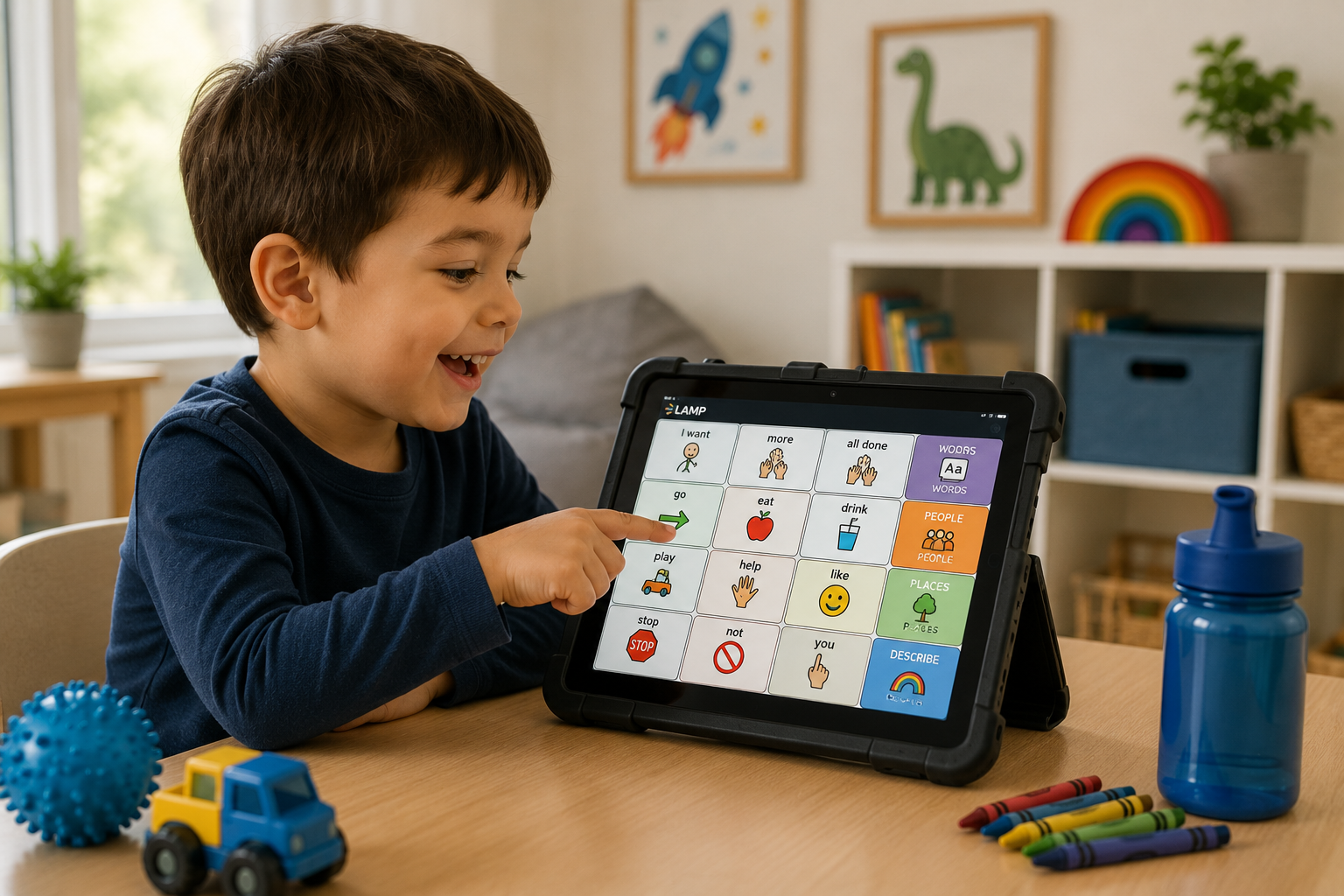
AAC can open the door to more connection, independence, and meaningful communication. Speechie Auntie provides pediatric speech therapy and AAC support to children and families in Leander, Texas and nearby communities.
First, What Is AAC?
AAC stands for Augmentative and Alternative Communication.
The word augmentative means that AAC can add to or support someone's existing communication.
The word alternative means that AAC can also provide another way to communicate when speech alone is not sufficient to meet someone's communication needs.
AAC can include:
Gestures
Manual signs
Facial expressions and body movements
Communication boards
Picture-based communication systems
Written words
Speech-generating devices
Communication applications
Dedicated communication systems
In other words:
AAC is not synonymous with an iPad.
An iPad may be the hardware on which an AAC application is installed, but the communication system itself is much more than the tablet.
Think about the difference between a laptop and the software running on it. We would not call Microsoft Word “a laptop.” In the same way, we should not reduce a robust AAC system to “an iPad.”
When a tablet is being used as a child's communication system, its purpose is fundamentally different from using a tablet to watch videos or play games.
Communication is not entertainment and access to communication should not be dismissed simply because the technology happens to have a screen.
There Are No Prerequisites for AAC
This is one of the most important things I want parents to understand:
There are no prerequisites for AAC intervention.
A child does not need to:
Be a certain age
Have a particular diagnosis
Demonstrate a certain IQ
Understand a certain number of words
Match pictures
Point on command
Demonstrate consistent joint attention
Have specific fine-motor skills
“Fail” traditional speech therapy
Stop developing spoken language
Have only a certain number of spoken words
Prove that they want an AAC system
AAC should be considered when a person's current communication abilities are not adequately meeting their communication needs.
That distinction matters.
The question should not be:
“Is this child impaired enough to deserve AAC?”
A much better question is:
“Does this child currently have an effective and reliable way to communicate everything they need and want to communicate?”
Can they ask for something?
Can they reject something?
Can they say no?
Can they ask for help?
Can they tell someone something hurts?
Can they protest?
Can they comment?
Can they ask a question?
Can they tell us what happened?
Can they participate socially?
Can they communicate when they are tired, overwhelmed, excited, scared, confused, or frustrated?
Can unfamiliar communication partners understand them?
Communication is much bigger than requesting a snack or favorite toy.
AAC Is Not a “Last Resort”
I strongly disagree with the idea that AAC should be held back until every attempt to develop speech has been exhausted.
Why would we deliberately give a child less access to language while we wait to see what happens with speech?
AAC and spoken language do not have to compete.
We can work on speech.
We can model language.
We can support gestures.
We can acknowledge vocalizations.
We can support signs.
We can use AAC.
All of those things can coexist.
This is multimodal communication, and it reflects how human beings actually communicate. Even speaking adults communicate through combinations of speech, facial expressions, gestures, writing, texting, pointing, pictures, and body language every single day.
The goal is not to force a child to choose one communication modality.
The goal is to make sure the child has a way to communicate.
“Your Child Already Has Enough Words.”
This is another reason families may hear for delaying AAC:
“She already has a lot of words.”
“He can talk.”
“She can tell us what she wants.”
Having spoken vocabulary does not automatically mean a child has adequate functional communication.
AAC is not reserved for children who have zero spoken words.
A child may be able to label dozens or even hundreds of objects and still have significant difficulty using language flexibly, spontaneously, and independently.
A child may know:
dog, cat, car, ball, apple, blue, dinosaur, numbers, letters…
but struggle to communicate:
I don't understand.
Something hurts.
I don't want to do that.
That's not what I meant.
Help me.
I need a break.
Where did Mommy go?
I want something different.
That scared me.
I have something to tell you.
Vocabulary size and functional communication are not the same thing.
This can be particularly important for children who demonstrate strong labeling skills, memorized language, scripts, echolalic language, or a collection of familiar words but have difficulty generating flexible, self-directed language across people, settings, and situations.
Instead of asking:
“How many words does this child have?”
we should be asking:
“Can this child communicate what they want to say, when they want to say it, to the people they need to say it to?”
AAC can augment existing speech.
That is literally what the first “A” in AAC means.
A child does not have to choose between being “verbal” and being an AAC user.
They can be both.
A Few Pictures or Magnets Are Not the Same as Access to a Robust Language System
Sometimes, when parents express concerns about their child's communication, they are encouraged to make a few pictures, magnets, or visual symbols representing commonly requested objects or activities.
Visual supports can absolutely be useful.
A picture showing shoes may help a child understand that it is time to leave.
A first/then board may support a transition.
A picture schedule may help a child anticipate what is happening next.
These are valuable tools.
However, we need to distinguish between a visual support and a communication system.
Imagine that a parent is told to create magnets containing pictures of the things their child commonly wants.
At first, that may sound simple and practical.
Think about who controls the vocabulary.
The adult does.
The parent has to anticipate what the child might want to communicate, find or create the picture, print it, laminate it, attach a magnet or Velcro, organize it, and make sure it is available at exactly the moment the child needs it.
Then there is a much bigger question:
What happens when the child wants to say something the parent did not anticipate?
Where is:
different?
again?
don't?
funny?
hurt?
remember?
later?
why?
not that one?
I have an idea.
A child can only communicate using the vocabulary that someone else decided to make available.
That can become an enormous limitation.
This is one reason parents should understand the difference between a small collection of pictures and a dynamic, robust AAC system.
In a dynamic AAC system, selecting a word or category can provide access to additional vocabulary. The child is not limited to the handful of symbols that happen to fit on the refrigerator, binder, or communication board that day.
A robust system can provide access to core vocabulary including high-frequency, flexible words such as go, stop, more, different, help, like, not, want, and you, alongside personally meaningful fringe vocabulary such as favorite foods, people, places, characters, and activities.
More importantly, that vocabulary can grow with the child.
This does not mean magnets, picture cards, visual schedules, communication boards, or low-tech AAC are “bad.”
Low-tech AAC can be incredibly valuable and may be the most appropriate option in certain situations.
The issue is not simply low-tech versus high-tech.
The question is:
Does this communication system provide this individual with sufficient access to language to say what they actually want to say?
We should be very careful about creating systems that essentially communicate:
Here are the things the adults predicted you might want. Pick one.
That is not the same as having broad access to language.
A communication system should not only help adults figure out what a child wants.
It should increasingly allow the child to communicate messages that the adults did not already know.
That is one of the most powerful things about communication.
Your child should be able to surprise you.
“He Isn't Interested in the AAC Device.”
This is another concern I hear frequently.
A child may receive access to AAC and initially:
Walk away from it
Push it aside
Explore buttons seemingly randomly
Press the same button repeatedly
Prefer another toy
Watch an adult use it without touching it
Touch it briefly and leave
Use it inconsistently
Appear completely uninterested
That does not automatically mean AAC isn't appropriate for that child.
Imagine handing a toddler a piano for the first time.
Would we expect them to immediately sit down and play a song?
Of course not.
We would expect exploration.
They might hit random keys. They might walk away. They might watch someone else play. They might come back later.
Over time, with exposure, modeling, repetition, and meaningful experiences, their interaction with the instrument may change.
Communication systems also require exposure, teaching, modeling, and time.
Children learning spoken language hear thousands upon thousands of words before anyone expects them to use those words independently.
AAC users deserve opportunities to see their language modeled, too.
We should not place a communication system in front of a child for a few sessions, observe that they are not immediately using it independently, and conclude:
“See? They're not interested.”
We also need to consider how AAC has been introduced.
Has it been available during activities that are actually meaningful to the child?
Are adults modeling it?
Are adults using it for more than requesting?
Does the vocabulary reflect the child's interests?
Is the child being given opportunities to explore without being corrected?
Or does the device appear primarily when an adult wants the child to “say” something?
Those experiences are very different.
Interest on Day One is not a prerequisite for communication access.
AAC Is More Than Requesting
Sometimes adults conclude that a child does not need AAC because the child can already get their basic wants and needs met.
Maybe they pull an adult toward the refrigerator.
Maybe they hand someone a container they cannot open.
Maybe they point.
Maybe they cry.
Maybe they use a few spoken words.
Maybe their parents understand their vocalizations.
Those are all meaningful forms of communication, and they should absolutely be honored.
However, I want us to aim higher than simply getting basic needs met.
A child's communication system should support language for many different purposes:
I don't like that.
That's funny.
Look at this!
I remember that.
I'm scared.
I need a break.
Where is Daddy?
That's mine.
I have an idea.
Leave me alone.
I want to tell you something.
Communication is not merely compliance and requesting.
Communication is autonomy, connection, self-advocacy, relationships, learning, personality, and participation.
When children do not yet have an effective way to communicate what they need, know, feel, or don't want, their behavior may communicate the message for them. I talk more about this connection in Behavior Is Communication: What Your Child Is Really Trying to Tell You.
“Won't AAC Stop My Child From Talking?”
Parents often worry that providing AAC will cause their child to stop trying to speak.
AAC should not be viewed as giving up on spoken language.
For many children, we are simultaneously supporting spoken language and providing another reliable way to communicate.
I often explain it to families this way:
Speech can remain a goal without speech being the price of admission to communication.
A child should not have to demonstrate that they can develop reliable speech before we give them access to another communication modality.
If spoken language grows, wonderful.
If AAC continues to support that spoken language, wonderful.
If AAC becomes an important long-term communication modality, wonderful.
The goal is effective communication, not allegiance to one particular form of communication.
If this is one of your biggest concerns, you may also want to read Will AAC Stop My Toddler From Talking?, where I take a closer look at AAC, spoken language, and what AAC support can look like in speech therapy.
“Isn't It Just an iPad?”
No.
This misconception deserves its own answer.
An AAC application may operate on an iPad or another tablet, but when that technology is functioning as someone's communication system, we need to think about its purpose.
A child watching a cartoon on a tablet and a child using a speech-generating application to say “I need help” are not engaging in equivalent activities simply because both involve a screen.
The hardware may look familiar.
Its function is entirely different.
We should evaluate AAC based on whether the communication system meets the child's communication needs not dismiss it simply because the software happens to run on consumer technology.
If you're concerned about screen time, I go into this topic in more detail in my article, Does AAC Count as Screen Time? A Speech Therapist Explains.
What About AAC at School?
Parents should understand an important distinction when their child attends public school.
Under the Individuals with Disabilities Education Act (IDEA), IEP teams must consider whether a student requires assistive technology devices and services.
AAC can fall under assistive technology.
If an IEP team determines that assistive technology is required for a student to receive a Free Appropriate Public Education (FAPE), the local educational agency is responsible for providing and maintaining the necessary assistive technology and services at no cost to the family.
This does not mean that every child automatically qualifies for a particular speech-generating device, application, or communication system simply because a parent requests one.
AAC selection should be individualized.
Different children have different language, sensory, motor, visual, cognitive, and access needs. Assessment and trials may be necessary to determine what system, vocabulary organization, access method, and supports are appropriate.
Decisions should be based on the individual child's communication needs.
They should not be based on blanket assumptions such as:
“AAC is a last resort.”
“He's too young.”
“She already has too many words.”
“He needs to talk more first.”
“She wasn't interested when we showed it to her.”
or
“It's an iPad, so it will be distracting.”
Parents can ask their child's IEP team:
Has assistive technology and AAC been formally considered for my child?
What information was used to make that determination?
What AAC systems or access methods have been considered or trialed?
How long were they trialed?
In what environments and activities were they trialed?
How was AAC modeled during those trials?
How were my child's receptive and expressive communication abilities considered?
How will AAC be modeled throughout the school day?
Who will train the staff members working with my child?
How will the family be supported in learning the system?
If AAC is not being recommended, what is the individualized rationale for that decision?
Those are reasonable questions.
“If My Child Needs AAC, Why Doesn't the Private SLP Just Provide a Device?”
This is an important question, and the answer requires separating clinical support for AAC from funding and ownership of AAC equipment.
A private speech-language pathologist can play an important role in the AAC process.
Depending on the clinician's training, practice model, resources, and scope of services, that may include:
Identifying unmet communication needs
Discussing AAC with families
Conducting or recommending AAC assessment
Exploring or trialing different communication approaches
Modeling AAC during therapy
Supporting language development through AAC
Training caregivers
Collaborating with school teams and other professionals
Helping identify features a child may need in a communication system
However, recommending and supporting AAC is different from a private clinician personally purchasing a dedicated communication system for every client who may benefit from one.
Robust AAC may involve hardware, communication applications or software, protective equipment, mounting or alternative-access equipment, warranties, programming, training, and ongoing support. Costs and funding pathways vary considerably.
Private practices also differ in the number and types of trial systems they own and the funding processes they are equipped to navigate.
A clinician's inability to personally purchase a dedicated system for a child should never be confused with a belief that the child does not need or deserve AAC.
Families may obtain AAC through different funding pathways depending on the individual child and circumstances, including educational systems, insurance or other funding sources.
For a child receiving special education services through a public school, there are also specific federal requirements surrounding assistive technology. When an IEP team determines that assistive technology is necessary for the child to receive FAPE, the school is responsible for providing the required assistive technology devices and services at no cost to the family.
This is why collaboration can be so important.
Families, private SLPs, school-based SLPs, teachers, occupational therapists, assistive technology professionals, and other members of the educational team may each bring valuable information about how the child communicates in different environments.
AAC should not become a battle between the private therapist and the school therapist.
It should be a collaborative process centered on one question:
What does this child need in order to communicate as effectively and independently as possible?
If you're preparing for an ARD or IEP meeting, you may also find Thinking About Bringing a Speech Therapist to Your ARD Meeting? Read This First helpful for understanding some of the differences between private and school-based speech-language services.
Giving a Child AAC Is Not Enough
There is another side of AAC advocacy that is equally important:
Access to a communication system without appropriate support is not enough.
We cannot hand a child a device and expect them to independently figure out how to use it.
AAC implementation may require:
Consistent access to the communication system
Modeling without constant pressure to imitate
Vocabulary that is meaningful to the individual child
Opportunities to communicate for many different purposes
Training for caregivers and professionals
Appropriate access methods
Time for exploration
Respect for all communication modalities
Coordination across environments
Ongoing assessment and adjustment
Adults need to learn the system, too.
If everyone around a child communicates primarily through speech while the child is expected to learn an unfamiliar communication system independently, we have created an enormous imbalance.
We have to model the language we are asking the child to learn.
AAC Should Not Become a Compliance Tool
AAC is a child's communication system, not a test.
We should be careful about constantly saying:
“Use your device.”
“Tell me on your talker.”
“Find it.”
“Say it with your device.”
“What do you want?”
“Show me.”
Imagine if every time you spoke, someone evaluated whether you said the sentence correctly.
Communication would become exhausting very quickly.
AAC modeling should include communication without expectation.
Adults can use the child's system to comment, react, joke, describe, protest, ask questions, and connect without requiring the child to immediately copy them.
If a child communicates successfully through speech, a gesture, a facial expression, a vocalization, a sign, or another meaningful modality, we should recognize that communication rather than withholding acknowledgment until the child reproduces the message on a device.
AAC should expand communication opportunities.
It should not create another hoop a child has to jump through to be heard.
Sometimes the most powerful thing we can do is model language and then give the child space.
Parents, You Are Allowed to Ask Questions
If you are told that your child is “not ready” for AAC, it is okay to ask:
“What specific prerequisite are you saying my child needs to demonstrate before AAC can be considered?”
If you are told AAC is a “last resort,” ask:
“Why would we need to wait until other communication approaches fail before providing an additional way to communicate?”
If you are told your child “already has enough words,” ask:
“Are we evaluating the number of words my child can say, or whether my child can communicate effectively across functions, people, and environments?”
If you are told your child “isn't interested,” ask:
“How long has the system been available, how has it been modeled, and in which meaningful activities has my child had opportunities to explore and use it?”
If you are told an AAC system would be “too distracting because it's an iPad,” ask:
“Are we evaluating the communication system based on my child's communication needs, or making an assumption based on the hardware that houses it?”
If you are offered only a handful of pictures for requesting, ask:
“How will my child communicate messages that aren't represented by these pictures?”
And:
“How will this system grow as my child's language and communication needs grow?”
You do not have to enter an IEP meeting ready for a fight.
However, you are absolutely allowed to enter it informed and ready to ask thoughtful questions.
The Bottom Line
AAC is not a last resort.
AAC does not require prerequisites.
AAC does not require a child to have zero spoken words.
Having “enough vocabulary” does not automatically mean a child has adequate functional communication.
AAC does not require a child to stop working on speech.
AAC is not simply an iPad.
AAC does not require immediate interest.
A few adult-selected pictures are not automatically equivalent to access to a robust language system.
AAC should never be reduced to requesting preferred items.
AAC does require thoughtful assessment, individualized decision-making, meaningful modeling, appropriate support, sufficient vocabulary, and opportunities to communicate for many different reasons.
Most importantly:
Children should not have to earn access to communication.
When a child's current communication is not adequately meeting their needs, our job is not to keep moving the finish line until they finally qualify for another way to communicate.
Our job is to ask:
What can we do to give this child greater access to language, connection, autonomy, self-advocacy, and a voice right now?
Communication should never be the last resort.
Looking for AAC Support in Leander, Texas?
If you are wondering whether AAC may be appropriate for your child, have questions about your child's current communication system, or want support understanding AAC recommendations, I would be happy to help.
At Speechie Auntie, PLLC, I provide individualized pediatric speech and language therapy, AAC support, and caregiver coaching for children and families in Leander, Texas and surrounding communities. My goal is to help families better understand their child's unique communication profile while building practical strategies that support meaningful communication at home and in everyday life.
Every child deserves access to communication, and every family deserves clear information to help them advocate for it.
For families looking for individualized support, you can also read How to Choose a Pediatric Speech-Language Pathologist in Leander, TX for guidance on what to look for when choosing a provider.
