

If you’ve ever walked out of an ARD meeting feeling overwhelmed, confused, or unsure what just happened, you’re not alone.
Many parents come into these meetings expecting clear answers and leave with more questions, especially when it comes to speech and language services. You might hear terms like “push-in support,” “minutes per week,” or “within the classroom setting,” and wonder:
Is this actually enough for my child?
What does this even look like day to day?
Am I allowed to ask for something different?
If you’re asking these questions, you’re already doing exactly what your child needs, paying attention and advocating.
Somtimes, that’s where bringing a private speech therapist into the meeting can help.
Many families first reach out for support with toddler communication concerns before navigating the ARD process.
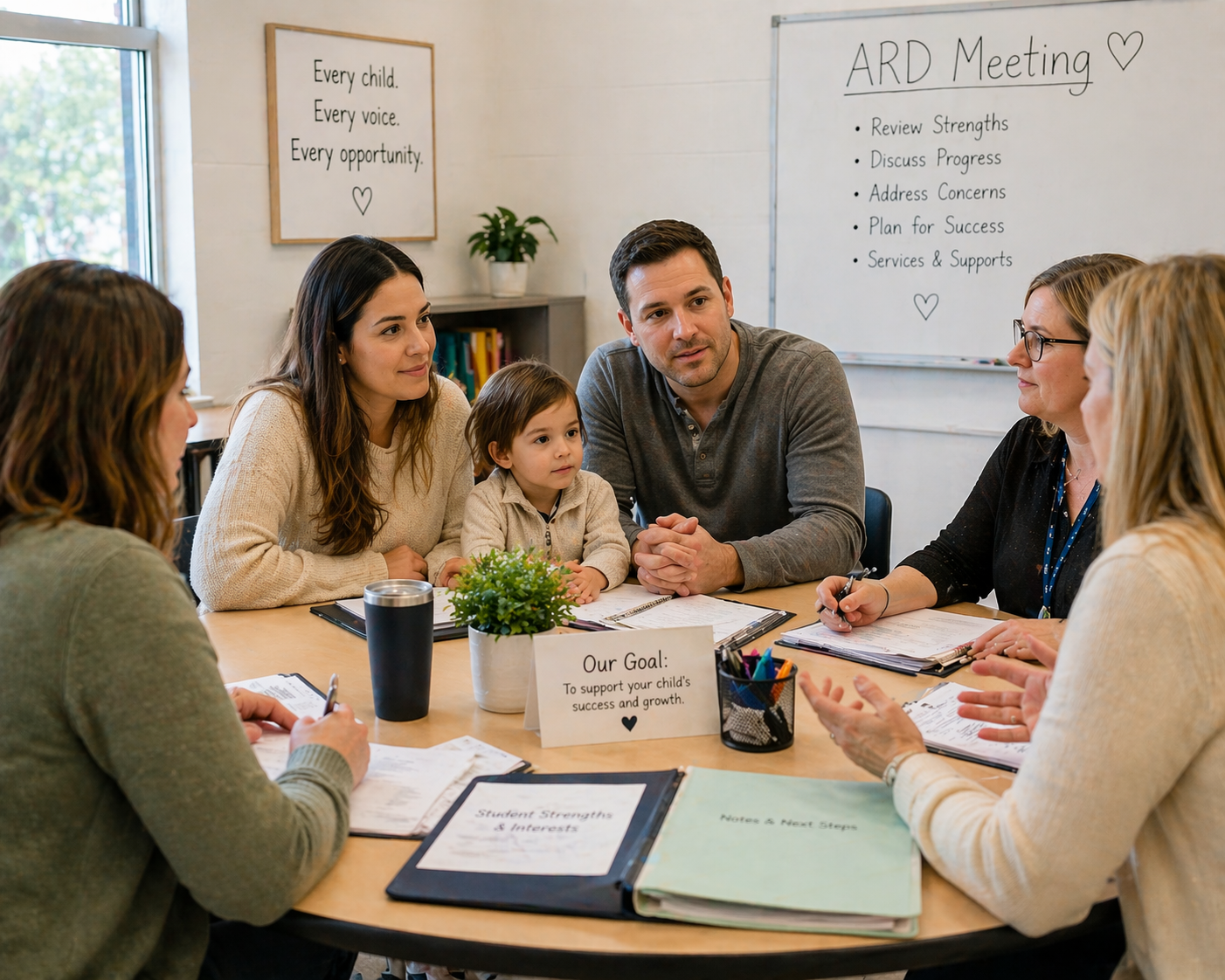
ARD meetings bring families and school teams together to support a child’s communication and learning goals.
What Is an ARD Meeting?
In Texas, special education decisions are made during an Admission, Review, and Dismissal (ARD) meeting.
This is where the school team reviews evaluations, discusses your child’s needs, and determines what services and supports will be provided.
You’ll likely have several people at the table, teachers, specialists, administrators, and it can feel like a lot to process in real time.
Can You Bring a Speech Therapist to an ARD Meeting?
Yes. Parents are allowed to bring someone with them to an ARD meeting, including a private speech-language pathologist.
This isn’t about challenging the school. It’s about making sure you feel supported, informed, and confident in the decisions being made for your child.
Why Some Families Choose to Bring a Private SLP
Every family is different. Some feel comfortable navigating the meeting on their own. Others prefer having someone there to help translate, clarify, and support.
Here are a few reasons families choose to bring a private speech therapist:
To Help Interpret Evaluation Results
School reports can be full of technical language. A private SLP can help break things down in a way that makes sense and connect it back to what you’re seeing at home.
To Ask the Right Questions
Sometimes it’s not about disagreeing. It’s about knowing what to ask.
Questions like:
How will this support look during the school day?
How will progress be measured?
Is this level of support enough to build foundational skills?
To Bridge the Gap Between School and Home
What a child does in a structured classroom setting can look very different from what families see at home. A private SLP helps connect those two environments so decisions reflect the whole child, not just one setting.
Reviewing Your Child’s Evaluation, What I’m Actually Looking For
When families ask me to attend an ARD meeting, one of the most important parts of my role happens before we ever sit down at the table.
I take the time to carefully review your child’s evaluation from start to finish.
This isn’t a quick skim. I’m looking at the full picture to make sure everything aligns with your child’s current communication skills.
That includes:
Whether the results match what you’re seeing at home
Whether the recommendations are supported by the data
Whether the goals are functional and meaningful for your child’s day-to-day life
Whether anything needs clarification before the meeting
Sometimes, that means noticing areas that may need to be explained more clearly or expanded on so you can feel confident in what’s being recommended.
My goal isn’t to pick apart the evaluation. It’s to make sure you walk into the meeting understanding what it says, what it means, and how it impacts your child.
If something feels unclear, inconsistent, or doesn’t fully reflect your child, we talk through it ahead of time so you’re not processing it for the first time at the table.
What a Private Speech Therapist Actually Does in the Meeting
There’s a common misconception that bringing an outside provider makes the meeting confrontational.
That’s not the goal.
When I attend ARD meetings with families, my role is to:
Listen and observe
Help parents process information in real time
Offer clinical insight when appropriate
Keep the focus on functional communication
It’s about collaboration, not conflict.
When School Support Feels Limited
It is not uncommon for families to be offered brief, classroom-based speech services delivered in a group setting, often structured as approximately 15 minutes per session, around 14 times within a 9-week grading period.
For some children, that level of support may be appropriate.
However, for most children who are still developing foundational communication skills such as imitation, joint attention, and early language short, infrequent sessions in a busy classroom environment may not always provide the level of intensity needed to build those skills.
This doesn’t mean anyone is doing anything wrong. School-based services and private therapy often have different roles and structures.
School services are designed to support access to the classroom.
Private therapy is often able to focus more directly on building underlying communication skills.
At this stage, the focus isn’t just on minutes, it’s on whether the support provided is enough to help your child build meaningful communication skills.
Common Things That Can Be Confusing in ARD Meetings
Minutes vs. Meaningful Support
It’s easy to focus on the number of minutes listed in a plan. However, what matters just as much is how those minutes are used and whether they match your child’s needs.
Push-In vs. Direct Therapy
Classroom-based support can be helpful, but for some children, especially those still developing foundational communication skills, more direct, individualized support may be needed.
“They’re Doing Fine at School”
This is something many parents hear.
Communication isn’t just about compliance or participation in a structured setting. It’s about:
expressing wants and needs
engaging socially
building language across environments
A child can appear “fine” in one setting and still need support.
When It Might Make Sense to Bring Support
You don’t have to bring anyone to an ARD meeting.
However, it may be helpful if:
You feel unsure how to interpret the evaluation results
You’ve left past meetings feeling confused
You’re being presented with recommendations you don’t fully understand
You want help connecting school-based support to real-life communication
Sometimes just having someone there to slow things down and walk through it with you can make a big difference.
My Approach When Supporting Families
If I attend an ARD meeting with a family, my goal is always the same:
To support the parent while maintaining a collaborative, respectful relationship with the school team.
We’re all working toward the same outcome, helping your child communicate more effectively.
I focus on:
functional, meaningful communication
development of foundational skills
making sure recommendations align with your child’s current level
Not just what sounds good on paper.
Final Thoughts
ARD meetings can feel like a lot. There’s a lot of information, a lot of terminology, and often pressure to make decisions in the moment.
You don’t have to navigate that alone.
Whether you bring a speech therapist, an advocate, or simply take time to ask more questions, you’re allowed to slow things down and make sure you understand what’s being recommended for your child.
Already on my caseload and preparing for an ARD meeting?
If your child is currently receiving private speech therapy, it’s important to understand that school-based speech services are determined by educational impact and often look very different in terms of time, setting, and intensity.
Families I work with in Leander and Cedar Park are often surprised by how limited school-based speech services can be compared to the individualized support their child receives in private therapy.
If your child is currently on my caseload and has an upcoming ARD (IEP) meeting, I can help you:
understand the school’s recommendations
feel more confident advocating for appropriate speech services
Written by Sonia Chowdhury Lopez, M.S., CCC-SLP
Owner and Speech-Language Pathologist at Speechie Auntie
