

When parents hear the term speech therapy, many assume it only helps children pronounce sounds correctly. In reality, pediatric speech therapists support many aspects of communication and development, including language, social interaction, play skills, and functional communication through play-based pediatric speech therapy services designed to meet each child’s developmental needs.
As a speech-language pathologist and the owner of Speechie Auntie, I primarily work with toddlers and preschoolers in the Leander and Cedar Park area. Many of the families I meet are unsure what a speech therapist actually does or how therapy fits into their child’s care. This post explains the role of pediatric speech therapists and how we support young children and their families.
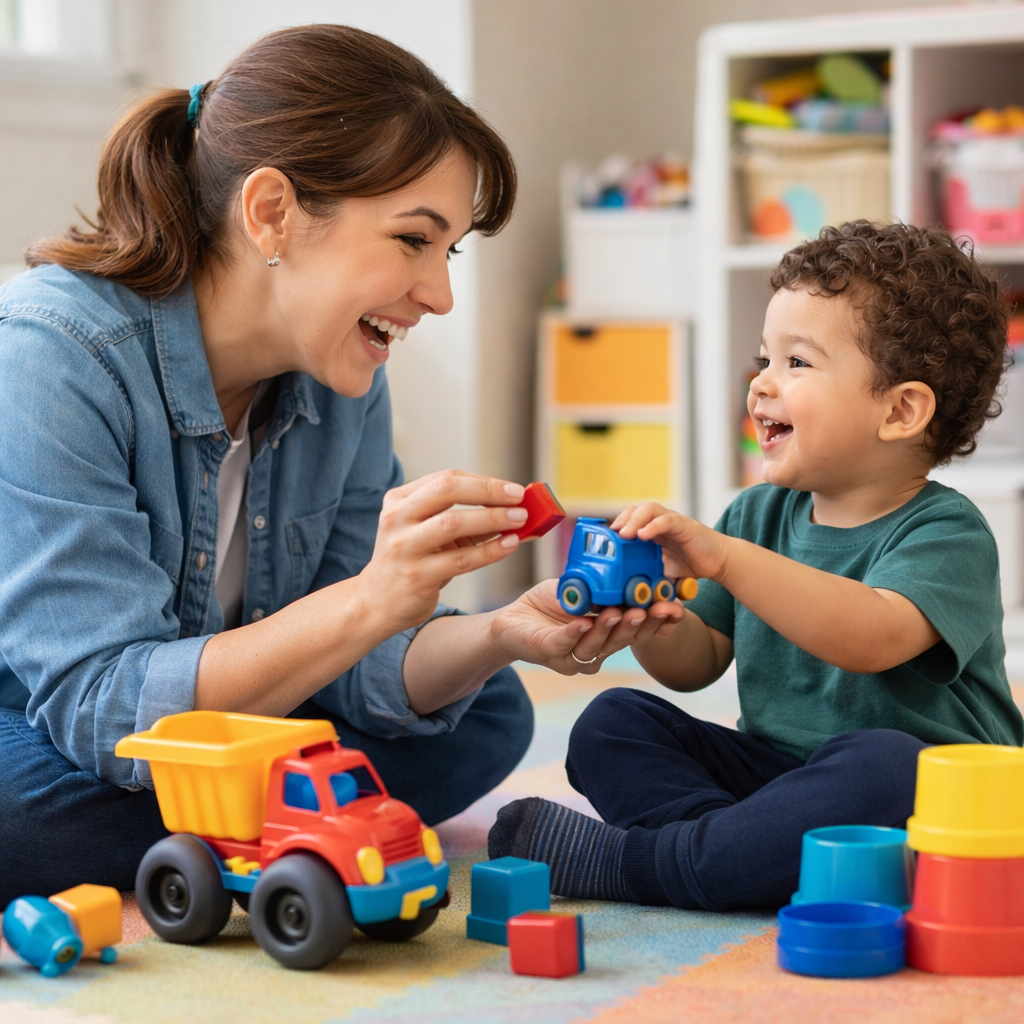
Play-based speech therapy helps toddlers develop communication skills through interaction, toys, and meaningful routines.
What Does a Pediatric Speech Therapist Do?
Pediatric speech therapists help children develop the skills they need to communicate effectively. Communication includes much more than talking. It also involves:
Understanding language
Expressing wants, needs, and ideas
Answering and asking questions
Using gestures and play to communicate
Participating in social interactions
Producing speech clearly enough to be understood
Many of the children I work with are:
Late talkers
Toddlers with language delays
Gestalt language processors (GLP) who communicate through scripts or echolalia
Autistic children learning to communicate in ways that feel natural for them
Preschoolers who have difficulty answering questions or expressing themselves
Speech therapy helps children build communication skills in ways that match their developmental stage and learning style.
Common Reasons Parents Seek Speech Therapy
Most parents don’t come to therapy because someone told them to. They come because their instincts are telling them something may not be developing as expected.
Some of the most common concerns I hear include:
“My toddler isn’t talking yet.”
“My child repeats phrases from TV or scripts lines.”
“My child doesn’t answer questions.”
“My child understands things but doesn’t say much.”
“My child is hard to understand.”
These concerns are valid, and early support can make a significant difference in helping children develop strong communication skills.
What Makes Pediatric Speech Therapy Effective
One of the most important parts of pediatric speech therapy is meeting children where they are developmentally.
Young children learn best through play and meaningful interactions, not worksheets or drills. Because of this, my sessions are primarily play-based and child-led, which keeps children engaged and motivated.
During sessions, we might use:
Books
Pretend play toys
Movement activities
Music
Games
Everyday objects
Children often feel like they are simply playing, but these activities are carefully designed to support language development, communication, and interaction.
Sessions are typically one hour long, allowing enough time to build rapport, follow the child’s interests, and create multiple opportunities for communication.
Why Parent Coaching Is So Important
One of the biggest misconceptions about speech therapy is that progress only happens during therapy sessions.
In reality, parents are the most important part of the therapy process.
Even if I see a child two or three times per week, parents are with their child every day. That means everyday routines, mealtime, bath time, playtime, and bedtime, are full of opportunities for language development.
This is why parent coaching is a major part of my approach. During sessions, caregivers learn strategies they can use throughout the day to support their child’s communication naturally.
When parents understand how to support communication at home, progress often happens much faster and becomes part of everyday life.
A Real Example: Understanding Scripting
I once worked with a child who communicated mostly by scripting phrases from shows and familiar routines.
His parents were concerned because he wasn’t answering questions and seemed stuck repeating the same phrases. They didn’t realize that their child was actually a gestalt language processor, meaning he learns language in larger chunks rather than single words.
Once we explained how his language system worked and supported him through appropriate strategies, everything changed. Instead of trying to stop the scripts, we used them as a bridge to more flexible language.
Understanding how their child processed language helped the family support him more effectively, and it significantly improved his ability to communicate.
Another Example: Supporting a Late Talker
I also work with many late talkers. In one case, a toddler had very few words and had been relying on adults to anticipate his needs.
A big part of therapy involved helping the family create opportunities for communication instead of filling in the gaps immediately. By slowing down, modeling language, and allowing the child space to communicate, he gradually began using more words and initiating interactions.
Often, small changes in how adults interact with a child can have a huge impact on communication development.
Collaboration with Other Professionals
Speech therapists are often part of a child’s larger developmental support team.
Depending on the child’s needs, collaboration may occur with:
Occupational therapists
Teachers
Pediatricians
Feeding specialists
Other early intervention providers
Working together helps ensure children receive well-rounded support across different areas of development.
A Common Misconception About Speech Therapy
One thing many parents are surprised to learn is that speech therapy is not always a quick fix.
Communication development takes time. Just like learning to walk or read, language skills build gradually through consistent support and practice.
Progress happens step-by-step, and therapy focuses on building strong foundations for long-term communication success.
Signs a Child May Benefit From a Speech Evaluation
Parents know their children best. If your gut is telling you something may not be developing as expected, it’s worth exploring.
Some signs a child may benefit from an evaluation include:
Limited words for their age
Difficulty answering questions
Frequent scripting or repeating phrases
Difficulty expressing wants and needs
Communication that seems behind peers
Early support can make a meaningful difference in helping children build strong communication skills.
One of the Best Ways to Support Your Child’s Communication
If there is one simple thing I recommend to parents, it is this:
Get down on the floor and play with your child.
Play is how young children learn language. When adults join them at their level, follow their interests, and interact naturally, it creates powerful opportunities for communication growth.
You don’t need fancy materials or structured activities. Simple play, shared attention, and responsive interaction can go a long way.
Final Thoughts
Speech therapists play an important role in supporting children’s communication, but therapy works best when it is collaborative, play-based, and integrated into everyday life.
When families understand how their child communicates and learn strategies to support them, communication development becomes part of daily routines, not just therapy sessions.
If you are a parent wondering whether speech therapy might help your child, trust your instincts. Early guidance and support can make a lasting difference.
If you are located in Leander or Cedar Park, I offer in-home speech therapy for toddlers and preschoolers, along with complimentary consultations to help families determine next steps.
You can learn more at Speechie Auntie or reach out to schedule a consultation.
If you’re concerned about your child’s speech or language development and want personalized support, learn more about my pediatric speech therapy services in Leander and Cedar Park.
Written by Sonia Chowdhury Lopez, M.S., CCC-SLP
Owner and Speech-Language Pathologist at Speechie Auntie
