

Does AAC Count as Screen Time? A Speech Therapist Explains
If your child uses an AAC device or your speech therapist has recommended AAC, you may have wondered:
"Does AAC count as screen time?"
As a pediatric speech-language pathologist serving families throughout Leander, Cedar Park, and surrounding Central Texas communities, this is one of the most common questions I hear from parents.
The short answer is no. AAC use is not considered screen time.
Although many AAC systems are displayed on tablets or speech-generating devices with screens, AAC is a communication tool, not an entertainment device. Understanding the difference can help families feel more confident when supporting their child's communication development.
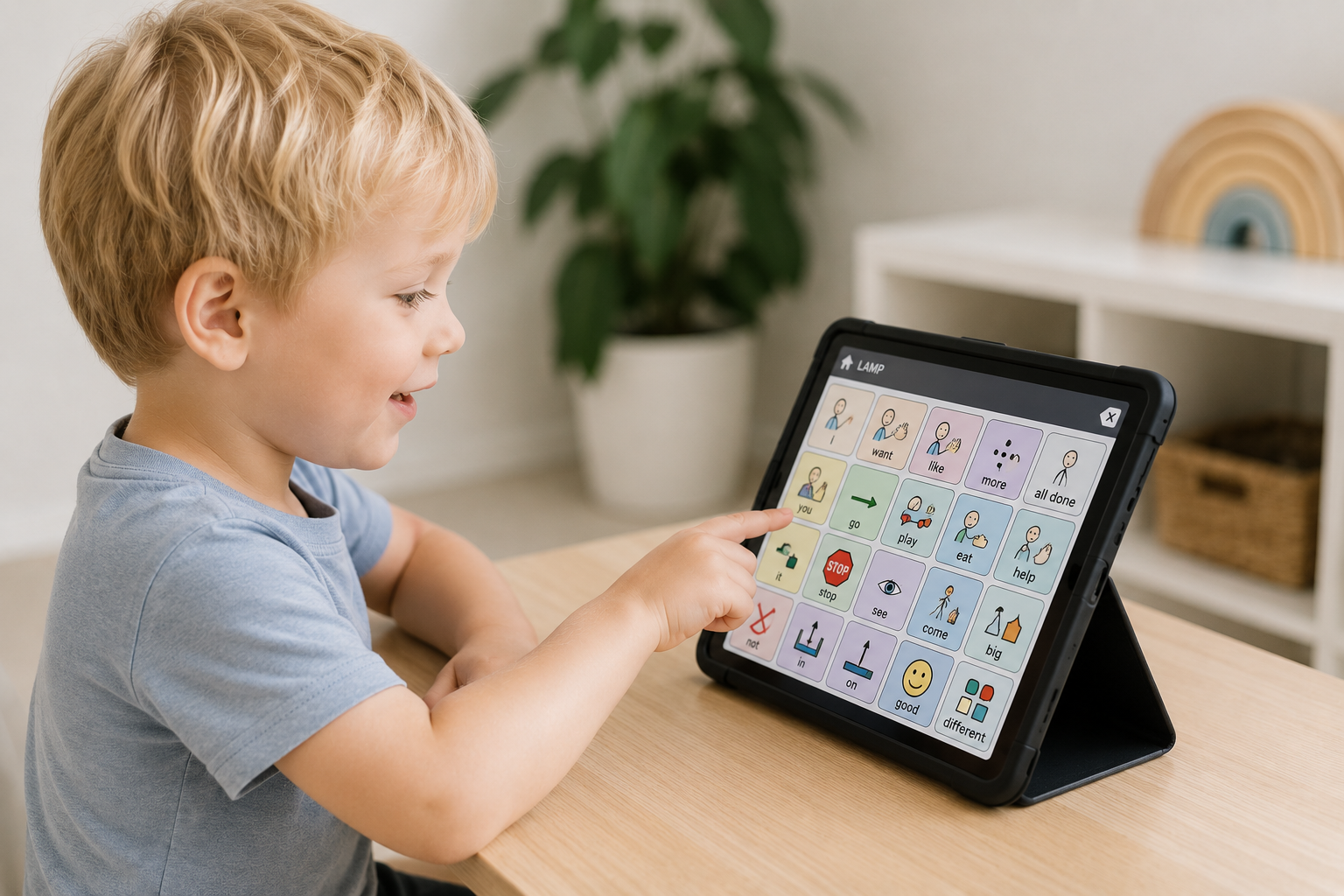
AAC devices are communication tools that help children express their thoughts, wants, needs, and ideas.
What Is AAC?
AAC stands for Augmentative and Alternative Communication. AAC includes tools and strategies that support communication for children who have difficulty using spoken language consistently.
Examples of AAC include:
Speech-generating devices
AAC apps on tablets
Picture communication boards
Communication books
Sign language
Gestures and visual supports
Many children with speech delays, autism, childhood apraxia of speech, developmental language disorders, and other communication differences benefit from AAC.
At Speechie Auntie, AAC is often incorporated into speech therapy sessions to help children communicate more effectively while continuing to build their language skills.
Why AAC Is Not Considered Screen Time
When most parents think about screen time, they think about:
Watching YouTube videos
Playing games
Streaming television shows
Scrolling through apps
Passive entertainment
AAC use is fundamentally different.
When a child uses an AAC device, they are actively communicating. They may be:
Requesting a snack
Asking for help
Answering questions
Sharing ideas
Expressing feelings
Participating in conversations
Learning new vocabulary
Building language skills
Communication is not entertainment.
Using an AAC device is more similar to talking, writing, or signing than it is to watching a video or playing a game.
AAC Devices Are Communication Tools
One way to think about AAC is to compare it to other assistive technology.
A child who wears glasses is not spending "too much time" looking through their glasses.
A child who uses hearing aids is not spending "too much time" using their hearing aids.
Similarly, a child who uses AAC is accessing a communication tool that helps them participate in everyday life.
The presence of a screen does not change the purpose of the device.
Should AAC Be Available All Day?
In most cases, yes.
Children who rely on AAC should have access to their communication system throughout the day, just as speaking children have access to their voice throughout the day.
Families can absolutely set limits on recreational screen use, including:
Television
Video games
YouTube
Tablets used for entertainment
However, AAC should remain available because communication opportunities occur throughout daily routines, including meals, playtime, community outings, and family interactions.
Will AAC Prevent My Child From Talking?
Another common myth is that AAC will prevent speech development.
Research consistently demonstrates that AAC does not stop children from learning to talk. In fact, AAC often supports language development by providing a reliable way for children to communicate while speech skills continue to emerge.
Many children become more engaged, more socially connected, and more motivated to communicate when they have access to an effective communication system.
Speech Therapy and AAC in Leander, TX
If you have questions about AAC, speech delays, autism, late talking, or language development, working with a speech-language pathologist can help determine whether AAC may be beneficial for your child.
Speechie Auntie provides in-home pediatric speech therapy, AAC support, speech-language evaluations, and parent coaching for families throughout Leander, Cedar Park, and surrounding Central Texas communities, with a focus on play-based therapy, caregiver education, and neurodiversity-affirming practices.
Frequently Asked Questions
Does AAC count as screen time?
No. AAC is a communication tool used to express thoughts, wants, needs, and ideas. Speech-language pathologists do not consider AAC use to be recreational screen time.
At what age can a child start using AAC?
There is no minimum age requirement for AAC. Research supports introducing AAC whenever a child demonstrates communication needs, including during the toddler and preschool years.
Will AAC stop my child from talking?
No. Research shows that AAC does not prevent speech development and may support language growth.
Can AAC help children with autism?
Yes. AAC can support communication for many autistic children by providing an additional way to express wants, needs, thoughts, feelings, and ideas. AAC can be used alongside spoken language, gestures, and other forms of communication.
Does a child need to have autism to use AAC?
No. AAC is not only for autistic children. AAC can support children with many different communication needs, including speech delays, language delays, childhood apraxia of speech, genetic conditions, motor speech difficulties, and other developmental differences.
Can AAC be used on an iPad?
Yes. Many AAC systems are available on tablets such as iPads, while others are dedicated speech-generating devices. A speech-language pathologist can help determine which communication system is most appropriate for a child's individual needs.
The Bottom Line
AAC is not screen time.
AAC is communication.
Whether a child communicates through spoken words, gestures, sign language, pictures, or a speech-generating device, every child deserves access to a way to express themselves and connect with the people around them.
Wondering whether AAC might be right for your child?
Every child deserves a way to communicate. If you have questions about AAC, speech delays, autism, late talking, or language development, I'd be happy to help.
Schedule a complimentary consultation to discuss your child's communication needs and next steps.
Serving families in Leander, Cedar Park, and surrounding communities.
Written by Sonia Chowdhury Lopez, M.S., CCC-SLP
Owner and Speech-Language Pathologist at Speechie Auntie
