

Will AAC Stop My Toddler From Talking? What Parents Should Know
If you’ve recently heard the term AAC (Augmentative and Alternative Communication) and felt unsure, overwhelmed, or even scared, you’re not alone.
Many families in Leander and Cedar Park first hear about AAC when their toddler isn’t talking yet or has been diagnosed with autism or a speech delay.
A common fear quickly follows:
“Will AAC stop my child from talking?”
Let’s address that right away.
No. AAC does not delay speech. Research consistently shows the opposite.
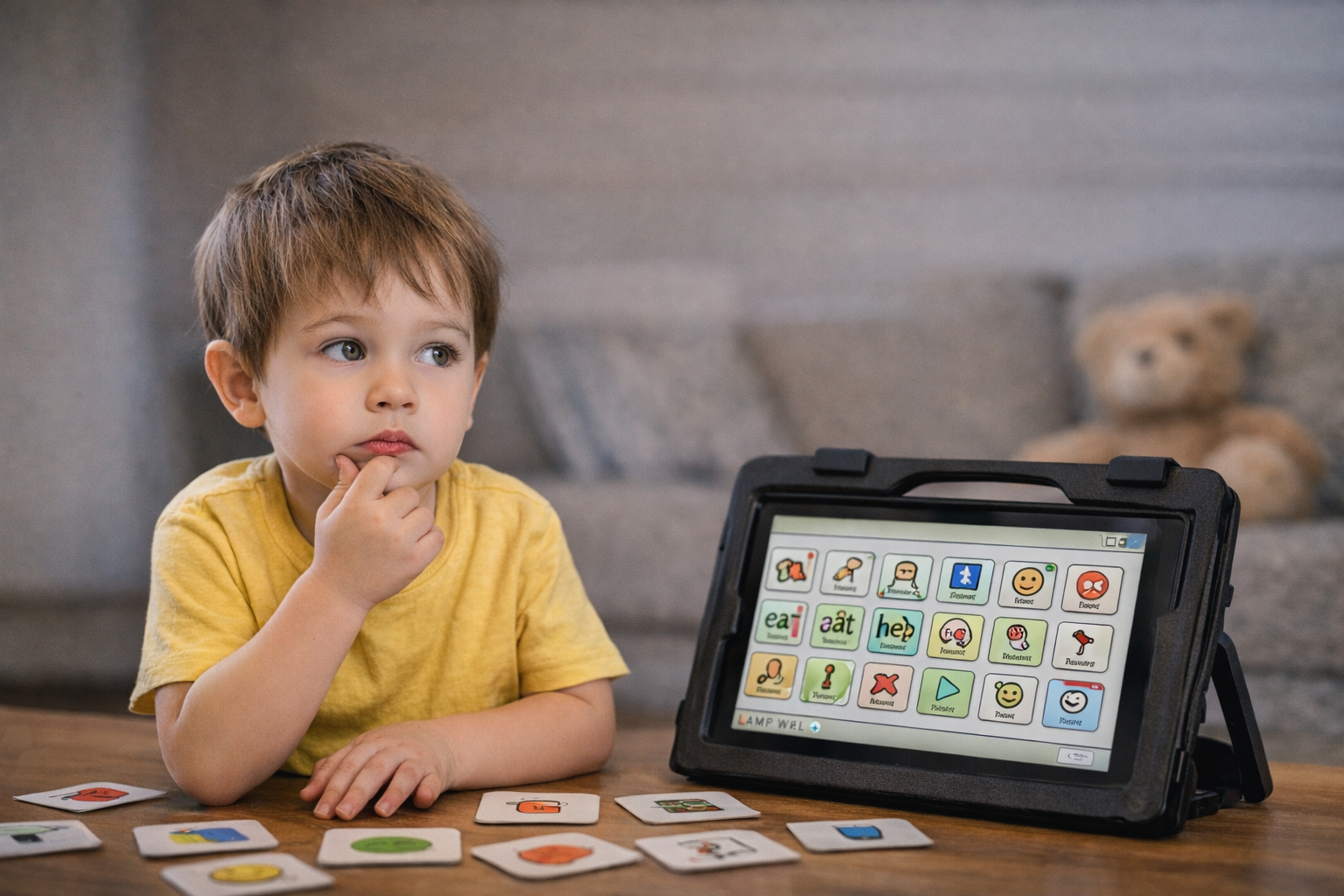
AAC gives toddlers access to communication before verbal speech fully develops.
What Is AAC?
AAC stands for Augmentative and Alternative Communication.
It includes any tool that helps a child communicate when spoken language is limited or difficult.
AAC can include:
Picture boards
PECS (Picture Exchange Communication System)
Communication books
Sign language
Speech-generating devices
iPad-based communication apps
AAC is not a “last resort.”
It is a bridge to communication.
Does AAC Delay Speech?
This is the most searched question about AAC.
The answer is clear:
Research shows AAC does not prevent or delay spoken language development.
In many cases, children actually develop MORE verbal language once they have access to AAC because:
Communication reduces frustration
Children experience successful interaction
They hear repeated language models
Pressure decreases
When communication increases, speech often follows.
Who Might Benefit From AAC?
AAC may support:
Autistic children
Minimally speaking toddlers
Late talkers with limited vocabulary
Children with apraxia of speech
Children with developmental delays
Children with complex medical needs
In early intervention and private speech therapy, AAC can be introduced very early, even before age 3.
Early access matters.
What AAC Looks Like in In-Home Speech Therapy
In-home AAC therapy is not just handing a child a device.
It includes:
Modeling language on the device
Teaching functional communication in routines
Reducing behavior caused by communication breakdown
Expanding vocabulary across daily activities
For example:
Instead of prompting a child to “say cookie,” we might model:
“Want cookie”
“More cookie”
“Eat cookie”
We build communication not compliance.
AAC and Autism
For many families of autistic children in Leander, Cedar Park, and surrounding communities, AAC becomes a powerful support tool.
It can:
Increase independence
Reduce meltdowns
Improve participation in daycare or preschool
Strengthen parent-child connection
AAC does not replace speech therapy.
It is part of speech therapy.
What Happens If the School Says Your Child Doesn’t Qualify?
Some families in Williamson and Travis County are told their child does not qualify for school-based services.
Private AAC therapy may offer:
More frequent sessions
Individualized vocabulary selection
Family-centered coaching
Home-based implementation
School minutes are often limited. Communication happens all day.
Signs Your Child May Need an AAC Evaluation
Consider an AAC evaluation if your child:
Uses fewer than 20 functional words after age 2
Relies heavily on gestures without words
Becomes frustrated when trying to communicate
Is not understood by familiar adults
Has a diagnosis impacting communication
Early support makes a difference.
You Are Not Giving Up on Speech
Choosing AAC does not mean you are giving up on spoken language.
It means you are choosing communication now.
Speech may develop.
It may not.
Communication should never be delayed while we wait to see.
In-Home AAC Therapy in Williamson & Travis County
Speechie Auntie provides in-home speech therapy and AAC support for toddlers and preschoolers across:
Leander
Cedar Park
North Austin
If your child is minimally speaking or you’ve been told to “wait and see,” you don’t have to navigate AAC decisions alone.
If you’re wondering whether AAC could support your child, schedule a consultation to discuss next steps. Communication starts with access.
Written by Sonia Chowdhury Lopez, M.S., CCC-SLP
Owner and Speech-Language Pathologist at Speechie Auntie
