

Let's talk about something that happens in living rooms everywhere.
You're sitting on the floor with your toddler. You've got the farm animals out. You're ready to build some language skills. You're feeling like a pretty fantastic parent.
And then it begins.
"What's this?"
"What does the cow say?"
"What color is the cow?"
"How many cows do you see?"
"Can you say cow?"
"Say mooooo!"
Meanwhile, your toddler has already moved on to putting the cow inside a dump truck.
You know what?
Your toddler might actually have the better idea.
As a pediatric speech-language pathologist providing in-home speech therapy in Leander and Cedar Park, Texas, I spend a lot of time helping parents understand something that can feel a little counterintuitive:
Sometimes, the best thing you can do for your child's language development is stop asking so many questions and start having more conversations.
Yes, really.
No, this doesn't mean questions are bad. It means we need to rethink how we use them.
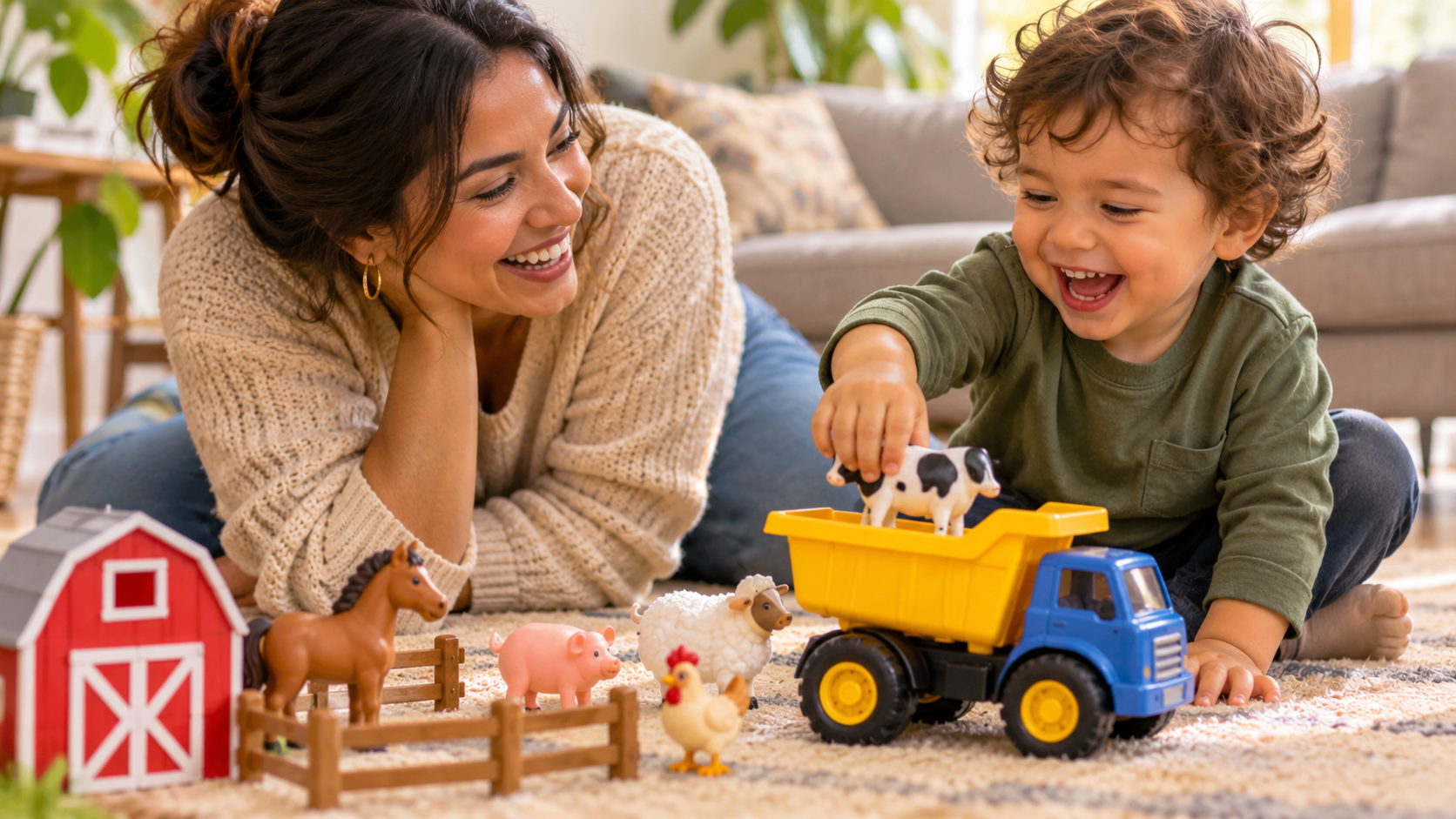
Who says cows can't drive dump trucks? Sometimes the best language-learning opportunities happen when we stop asking questions and start following our child's lead.
When Playtime Starts Feeling Like a Pop Quiz
Imagine sitting down with a friend for coffee.
You take your first sip, and your friend immediately asks:
"What are you drinking?"
"What color is it?"
"Is it hot or cold?"
"Can you say cappuccino?"
"How many cups are on the table?"
At some point, you'd probably wonder whether you were having coffee or taking an exam.
Now imagine being two years old.
You're exploring the world, figuring out how things work, and developing your ability to communicate. However, every time you pick something up, an adult asks you to identify it, label it, count it, or repeat a word.
That's a lot of pressure for someone who still occasionally thinks eating a crayon is a reasonable life choice.
Here's the thing: Children don't need to demonstrate what they know every time they play.
Sometimes, they just need opportunities to explore, connect, and communicate without being put on the spot.
Questions Aren't the Enemy. Constant Testing Is.
Before anyone throws away their question mark key, let me clarify something.
Questions are an important part of communication!
We ask questions to learn about one another, request information, make choices, and keep conversations going.
The issue isn't asking questions.
The issue is when our interactions with young children become a nonstop series of questions that already have an expected answer.
Think about the difference between these two situations.
Situation A: The Quiz Show
Your toddler picks up a toy dog.
You say:
"What's that?"
"What does a dog say?"
"What color is the dog?"
"Can you say dog?"
Your toddler walks away.
Situation B: The Conversation
Your toddler picks up the same dog.
You say:
"Oh! A dog!"
"Woof, woof!"
"That dog is running FAST!"
"Oh no! He fell down!"
Your toddler makes the dog jump off the couch.
You respond:
"Whoa! BIG jump!"
Same toy. Same child. Completely different interaction.
In the second situation, you're providing meaningful language models connected to what your child is already doing.
You're not requiring your toddler to prove anything before the fun can continue.
You're leaving room for your child to participate in whatever way feels accessible, whether that's through words, gestures, sounds, facial expressions, or actions.
Meet My Favorite Speech Therapy Strategy: Comment More, Question Less
One of the simplest strategies I teach families is to replace some questions with comments.
In speech-language pathology, we often refer to this as language modeling.
Instead of constantly asking your child to produce a word, you provide examples of language during meaningful interactions.
And the beautiful part?
You don't need a fancy toy, expensive subscription box, or Pinterest-worthy activity.
You can do this with practically anything.
Playing with Cars
Instead of:
"What color is the car?"
"How many wheels?"
"Can you say car?"
Try:
"Ready, set, GO!"
"That car is FAST!"
"CRASH!"
"Uh-oh! It broke!"
"Let's fix it!"
Playing with Bubbles
Instead of:
"What is this?"
"Can you say bubble?"
"What shape is the bubble?"
Try:
"BIG bubble!"
"Up, up, UP!"
"POP!"
"More bubbles!"
"All gone!"
During Snack Time
Instead of:
"What's this?"
"What color is your banana?"
"Can you say banana?"
Try:
"Yummy banana!"
"Peel it!"
"Squishy!"
"You want more!"
"All done!"
Notice something?
These examples are short, natural, and connected to what the child is experiencing.
You're giving your toddler useful language without making a spoken response the price of admission.
If your child communicates back with a look, a gesture, a sound, or a word?
That's an opportunity to respond and keep the interaction going!
Here's something I remind families all the time: You don't need to become your child's speech therapist. You just need strategies that make sense for your family. That's exactly why parent coaching is such an important part of my approach. When caregivers understand how to support communication during everyday routines, learning opportunities extend far beyond our therapy sessions.
How Will My Child Learn to Answer Questions?
This is usually where parents stop me.
"But Sonia, my child needs to learn how to answer questions!"
Absolutely!
Answering questions is an important language skill, and some children need direct support developing it.
Here's what I want families to understand:
A child benefits from opportunities to understand and use language, not just opportunities to be tested on it.
For example, before expecting a toddler to answer "Where's the dog?" consistently, we can model location words naturally during play.
"The dog is IN the house."
"He's UNDER the table!"
"Now he's ON the bed!"
As the child develops understanding and confidence, we can introduce meaningful questions within the interaction.
"Uh-oh! Where did the dog go?"
Then we wait.
Not every question needs to be answered immediately. Not every silence needs to be filled. Not every interaction needs to become a teaching moment.
Sometimes, the most powerful thing you can do is give your child a little extra time to process and respond.
Follow Your Child's Lead, Even When Their Idea Seems Ridiculous
Let's return to that cow riding in the dump truck.
Maybe you had planned to teach animal sounds.
Maybe you were hoping to work on identifying farm animals.
Maybe you spent twenty minutes setting up the perfect farm scene.
However, your toddler has decided that the cow is a construction worker.
Wonderful.
Now you have an opportunity to model:
"Cow is driving!"
"Beep, beep!"
"Move over!"
"BIG truck!"
"Cow goes BOOM!"
When we follow a child's interests, we can create opportunities for shared attention, connection, and meaningful communication.
That doesn't mean adults never guide play or introduce new ideas.
It means we recognize that our child's interests can be the starting point for learning rather than an obstacle to our lesson plan.
Sometimes, that cow really does need to drive the dump truck.
Now, following your child's lead doesn't mean abandoning all structure or letting your toddler run the entire show. There's a thoughtful balance between honoring a child's interests and providing meaningful guidance. I explore this further in my article, Child-Led Doesn't Mean Child-in-Charge, where I explain what child-led therapy actually looks like.
What If My Toddler Isn't Talking Yet?
If your toddler isn't using many spoken words, you might feel an even greater urge to ask questions, encourage imitation, or request that they "say" something.
I understand why.
When you're worried about your child's communication development, it can feel like you need to squeeze language practice into every possible moment.
Communication is so much bigger than spoken words.
Your child may already be communicating by:
Reaching toward something they want
Bringing you an object
Looking between you and a favorite toy
Pointing or using gestures
Making sounds or vocalizations
Using signs or an AAC system
Moving away to indicate they don't want something
These are meaningful forms of communication.
Instead of focusing exclusively on getting your child to repeat words, we can build on the communication they're already using.
For example, if your child reaches for bubbles, you might say:
"More bubbles!"
Then blow the bubbles.
You're modeling language while honoring their request.
You're not withholding the bubbles until they say the word.
You're showing them that their communication has meaning and that you are listening.
Of course, if your toddler has limited spoken language, difficulty understanding language, or other communication concerns, simply asking fewer questions isn't a substitute for an individualized speech-language evaluation.
Early support can help families better understand their child's unique communication profile and identify strategies that fit their needs.
Sometimes, a child can say plenty of words but still have difficulty using those words to communicate their wants, needs, thoughts, and feelings. If this sounds familiar, you might enjoy my article, My Toddler Can Say Words but Doesn't Use Them to Communicate. Why?, where I explore the difference between having words and using language meaningfully.
Here's Your Speechie Auntie Challenge
For the next 10 minutes of playtime, I want you to try something.
Put the questions on vacation.
Not forever. Just for 10 minutes.
Sit with your child and observe what interests them.
Instead of asking them to name, identify, count, or repeat everything, try describing what's happening.
Use playful sounds.
Make a silly comment.
Pause and see what your child does.
Respond to their communication, even when it doesn't involve words.
Most importantly?
Have fun together.
You might be surprised by how much more natural the interaction feels when nobody is being quizzed.
You may even notice new opportunities for back-and-forth communication.
Looking for more simple ways to encourage communication without buying another toy? Check out my blog, 5 Everyday Activities to Support Your Child's Speech and Language Development, for practical ideas you can incorporate into routines you're already doing at home.
The Takeaway: Connection Before Correction
As a pediatric speech-language pathologist, I love helping children develop their communication skills.
I don't believe childhood should feel like one long therapy session.
Our goal isn't to turn parents into full-time speech therapists.
It's to help families recognize the incredible communication opportunities already happening in their everyday routines.
Sometimes that means modeling a new word.
Sometimes that means waiting.
Sometimes that means responding to a gesture.
And sometimes?
It means putting the flashcards away and letting the cow drive the dump truck.
Meaningful communication grows through connection, shared experiences, and responsive interactions, not just through getting the right answer.
Looking for Pediatric Speech Therapy in Leander or Cedar Park, TX?
At Speechie Auntie, PLLC, I provide individualized, play-based, neurodiversity-affirming pediatric speech and language services in the comfort of your home.
My approach focuses on helping children develop meaningful, functional communication while empowering caregivers with practical strategies that fit naturally into everyday life.
I work collaboratively with families because you know your child best, and you deserve support that respects your child's unique developmental journey.
If you're concerned about your toddler's speech or language development, or you're wondering how to support communication without turning every interaction into a lesson, I'd love to connect.
Ready to support your child's communication through connection, play, and everyday moments? At Speechie Auntie, I help families in Leander and Cedar Park, TX, build meaningful communication skills without turning playtime into a pop quiz!
Let's connect and talk about your little one's communication journey!
