

Toddler Repeating Phrases from TV Shows, Movies, or Books (Echolalia): What It Means & How to Help
If your toddler is repeating phrases from TV shows, movies, or books, you might be wondering:
“Why are they talking like this?”
“Are they just copying… or do they understand?”
“Is this normal, or is this a speech delay?”
You’re not alone. This is one of the most common concerns parents have when their child’s language development doesn’t look the way they expected.
When toddlers repeat phrases they’ve heard before, it’s called echolalia. While it can feel confusing or even concerning at first, it’s often a meaningful part of how some children learn to communicate.
In many cases, children who use these repeated phrases are learning language through something called gestalt language processing, a style of development where children begin with whole phrases (or “scripts”) before breaking them down into smaller, flexible language.
The most important thing to know is this:
Your child is not just repeating words.
Your child is communicating.
Once you understand what those phrases mean and how to respond, you can support your child’s language in a way that actually works.
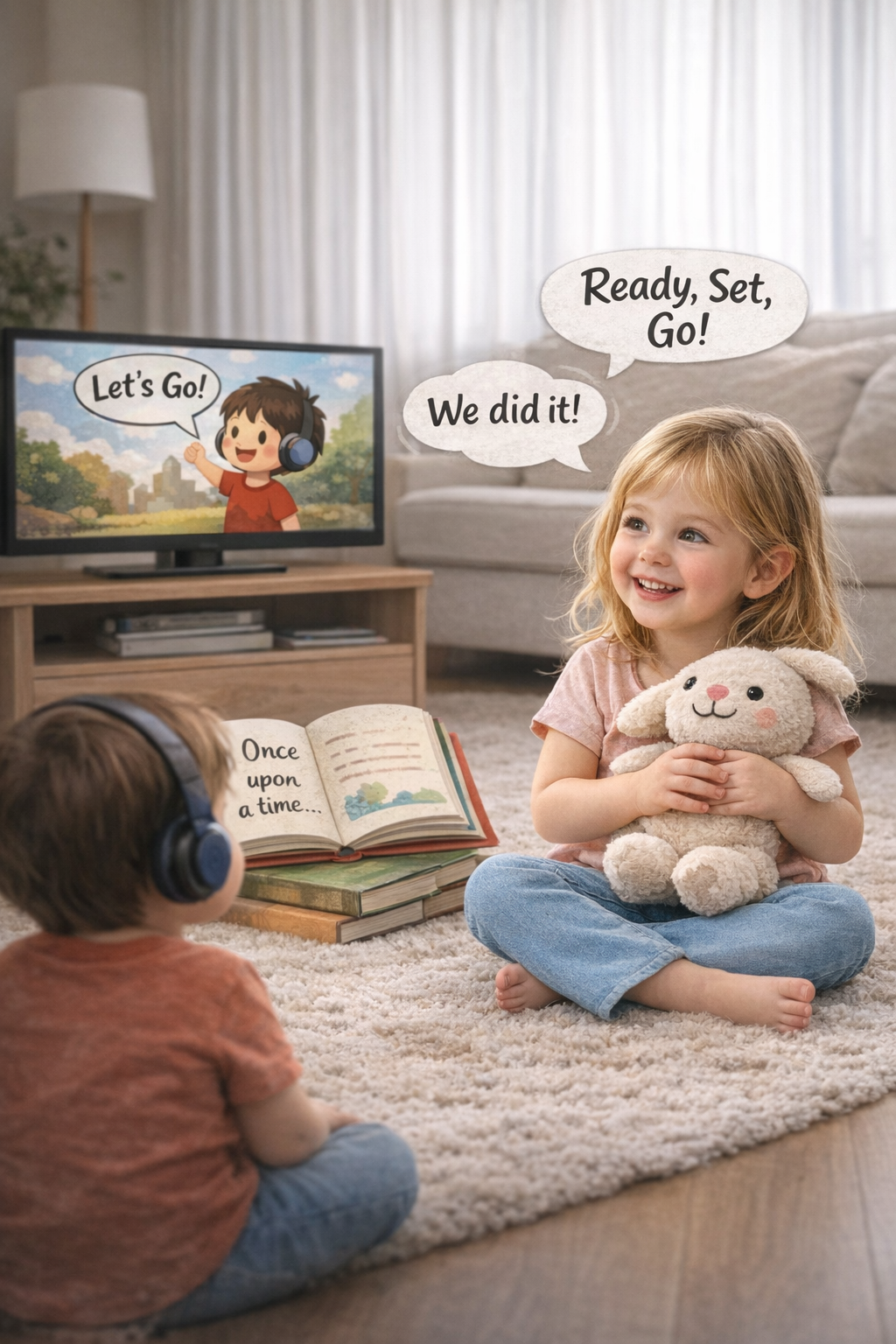
Some toddlers repeat phrases from TV shows, movies, or books as part of how they learn language.
What Is Echolalia?
Echolalia is when a child repeats words or phrases they’ve heard before.
It can show up in two main ways:
Immediate echolalia: repeating something right after hearing it
→ You say, “Do you want a snack?” and your child says, “Want a snack?”Delayed echolalia: repeating something heard earlier
→ Lines from TV shows, movies, books, or even things you say often
This might sound like:
“Rain, Rain Go Away”
“Time to clean up!”
“Thank you for joining”
Favorite character lines or song lyrics
At first, it can feel confusing, but here’s the shift:
These phrases are NOT random
They are often your child’s starting point for communication
Why Your Toddler Is Repeating Phrases And What It Means
Some toddlers are gestalt language processors, which means they learn language in chunks (phrases) instead of single words.
Instead of:
“ball” → “throw ball” → “I throw ball”
They might start with:
“Let’s throw the ball!”
These longer phrases are called gestalts.
Over time, with the right support, children can learn to:
Break these phrases apart
Recombine them
Create their own flexible, original language
That process doesn’t happen by forcing single words. It happens by building meaning from what they already use.
Do Toddlers Who Repeat Phrases Understand What They’re Saying?
This is one of the biggest questions parents have.
The answer is:
Often, yes. Just not in the way you might expect.
Children who use echolalia may be:
Requesting something
Expressing excitement
Protesting
Regulating their emotions
Participating in interaction
Example:
If your child says, “Ready, set, go!” they might be asking you to start an activity, not just repeating a phrase.
This is where we shift from:
“They’re just copying”
to
“They’re trying to communicate something”
Is Echolalia Normal or a Sign of a Speech Delay?
Echolalia can be a typical part of language development, especially in toddlers.
However, if your child:
Primarily communicates using repeated phrases
Isn’t yet using flexible, original language
Is difficult to understand or interpret
…it may be a sign they need support in how their language is developing.
It’s also important to know:
Echolalia is common in gestalt language processors
Some children who use echolalia may also be autistic but not all
Every child’s communication profile is different
This is why looking at the whole child matters more than labeling the behavior.
What NOT to Do When Your Child Is Scripting
When we don’t understand echolalia, it’s easy to respond in ways that accidentally slow progress.
Try to avoid:
Constantly correcting your child
Asking them to “say it the right way”
Overloading them with questions
Ignoring their scripts completely
Even with the best intentions, these approaches can increase pressure and reduce communication.
How to Help Your Toddler
Here’s what actually supports language growth:
1. Acknowledge the Script as Communication
Instead of correcting, respond to the meaning:
→ “You said ‘Let’s go!’ You’re ready!”
2. Model Natural, Simple Language
Give them flexible language they can use:
→ “Go!”
→ “Let’s go outside!”
3. Follow Your Child’s Lead
Join what they’re already interested in instead of redirecting.
Connection first, always.
4. Reduce Pressure
Less quizzing, more interaction.
Instead of:
“Say ball. What is it? Say ball.”
Try:
“It’s a ball! Bounce, bounce!”
5. Become a Language Detective
Ask yourself:
What might this phrase mean right now?
Over time, patterns start to make sense and communication becomes clearer.
Why This Matters for Families in Leander & Cedar Park
Many families in Leander, Cedar Park, and surrounding North Austin areas are told to “wait and see” or are given strategies that don’t match how their child actually learns.
If your child is a gestalt language processor, they need an approach that:
Builds on their existing language
Supports connection and regulation
Encourages flexible communication over time
This is exactly what I focus on in my work with families.
When to Seek Support
You might consider reaching out if:
Your child mostly uses scripts or repeated phrases
You’re not sure what their phrases mean
Communication feels frustrating for you or your child
You want to support them but don’t know how
Early support doesn’t mean something is “wrong.” It means you’re giving your child the tools they need.
Work With Speechie Auntie
At Speechie Auntie, I support families in Leander and Cedar Park through:
Complimentary discovery calls to learn more about your child and your concerns
Personalized in-home consults in your child’s natural environment
Comprehensive, play-based evaluations
Parent coaching so you feel confident supporting communication at home
Final Thoughts
If your toddler is repeating phrases from TV shows, movies, or books, they are not “just copying.”
They are communicating in the way their brain is currently organizing language.
When we meet them therewith the right support, understanding, and connection, that’s when real progress begins.
If your toddler is repeating phrases from TV shows, movies, or books, you’re not alone and this doesn’t mean your child isn’t learning to communicate. For many toddlers, echolalia is part of how language develops, especially for children who are gestalt language processors. The key is understanding what those phrases mean and how to respond in a way that supports real, functional communication. With the right approach, your child can grow from using scripts into more flexible, meaningful language over time. You don’t have to figure it out on your own. Getting the right support early can make a meaningful difference in how your child’s communication develops.
Written by Sonia Chowdhury Lopez, M.S., CCC-SLP
Owner and Speech-Language Pathologist at Speechie Auntie
