

TODDLER NOT TALKING YET? WHEN TO GET HELP FOR A SPEECH DELAY
When Is It Normal for Toddlers to Start Talking?
EVERY TODDLER DEVELOPS DIFFERENTLY (AND THAT’S OKAY). HERE’S WHAT TO KNOW.
It’s completely normal to compare your child’s speech to their peers, especially when one toddler is chatting up a storm while another is still babbling. As a pediatric speech-language pathologist serving families in the Leander and Cedar Park area, I often hear questions like:
“My little one just turned two years old and isn’t using many words. Should I be worried?”
“My child understands everything I say but doesn’t talk much. Is that normal?”
Rest assured, every child grows at their own pace. However, there are certain signs that can help you know when your little one might benefit from a bit of extra support from a local speech therapist.
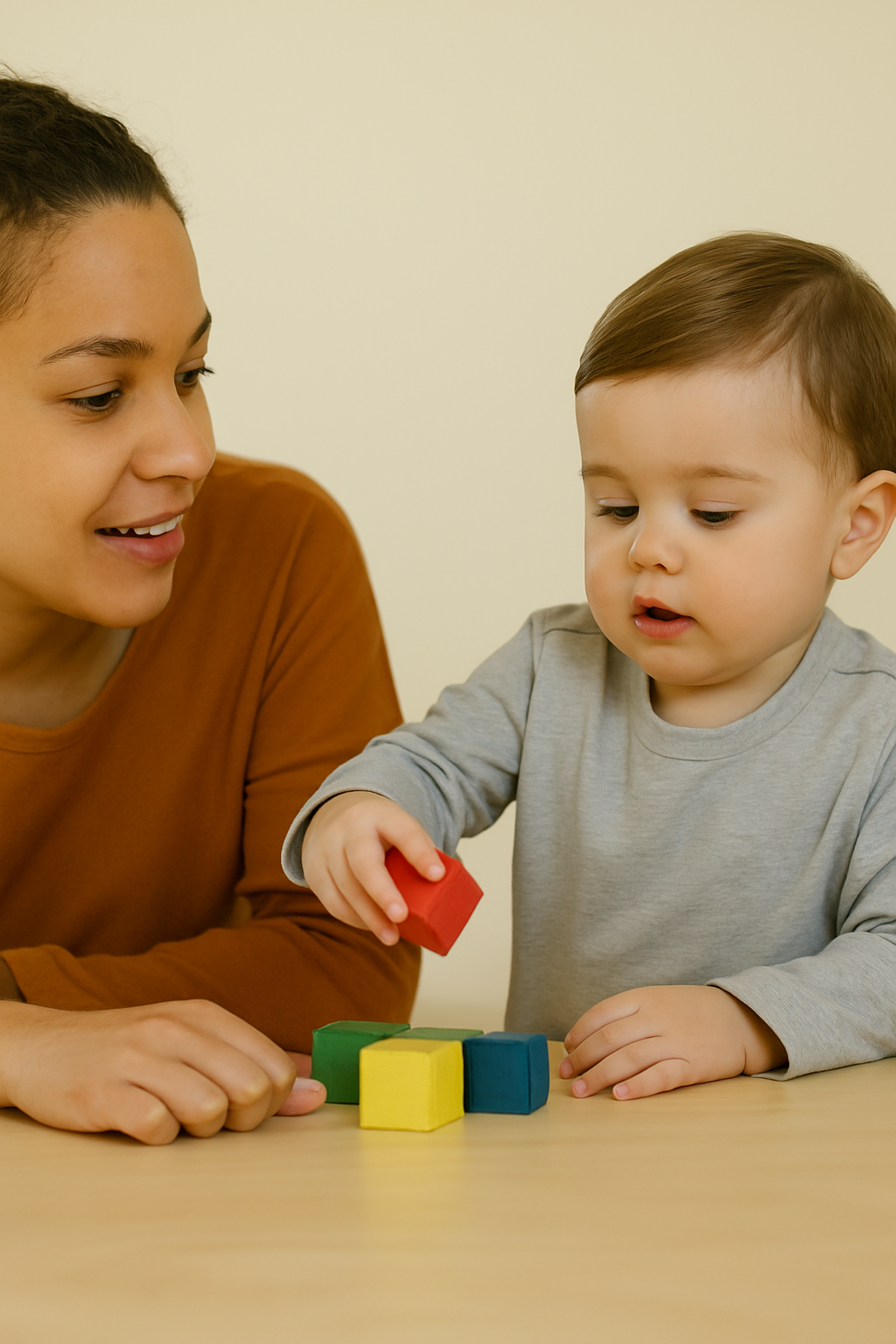
Play-based interaction helps build communication skills in toddlers who may not be talking yet.
SPEECH VS LANGUAGE: WHAT’S THE DIFFERENCE (AND WHY IT MATTERS)?
Parents often say, “speech delay,” but that phrase can mean a few different things. Some children have trouble saying words clearly, while others have trouble using or understanding words. Both are important, they aren’t the same thing.
Here’s a simple way to think about it:
Speech is how we make sounds and say words clearly. It’s about pronunciation, coordination, and the physical act of talking.
Language is the ability to understand and use words to share thoughts, needs, and feelings. It’s about meaning and connection.
Your child might understand everything you say but still have a hard time expressing their own ideas or vice versa. Knowing the difference helps us choose the right strategies to support your little one’s communication growth. Many late talkers also experience communication frustration and behavior challenges when they cannot express their needs.
Speech & Language Milestones to Watch
SPEECH AND LANGUAGE MILESTONES FOR TODDLERS (AGES ONE TO THREE)
Let’s take a look at what typical speech and language milestones might look like for toddlers ages one to three and signs it may be time to seek support.
Typical Speech & Language Milestones (Ages 1–3)
| Age | What’s Typical | When to Check In |
|---|---|---|
| 12 months | Babbling, saying 1–2 words like “mama” or “dada,” responding to name | No babbling or response to name |
| 18 months | Using 10–20 words, pointing to familiar people or objects | Not using words to communicate wants |
| 24 months | Using 50+ words, beginning two-word combinations (“more milk”) | No words or limited imitation of sounds |
| 36 months | Using 200+ words, forming short sentences (“I want cookie”); speech is easier to understand | Hard for others to understand most of what they say |
Signs Your Toddler May Have a Speech Delay
If you notice your child isn’t meeting a few speech and language milestones or progress seems to be stuck, reaching out to a speech therapist near you can help you understand what’s going on and how to best support your child’s growth. Environmental influences, including screen time and language development, can impact how toddlers build communication skills.
WHEN TO WORRY (AND WHEN NOT TO)
What’s typical at this stage:
Understands directions like “Get your shoes”
Uses gestures such as pointing, waving, or reaching
Tries to imitate sounds or words
Adds new words gradually
When to Reach Out for Support:
Rarely vocalizes, even when excited
Doesn’t respond to name or familiar voices
Lost words they used before
Relies only on gestures or crying
No new sounds for months
Should I Wait or Seek a Speech Evaluation?
You don’t have to panic. Just reach out. Seeking help early doesn’t mean something is “wrong.” It means you’re giving your child extra tools and support to thrive in their own unique way. Early intervention is about building a solid foundation, not assigning labels. A speech therapist can help you better understand your child’s communication profile and provide you with specific strategies that fit your family.
Sometimes doctors or well-meaning friends may suggest “waiting to see what happens,” but waiting too long can delay valuable early support. Speech therapy for toddlers is most effective when started early, even if it’s just for guidance and peace of mind. The earlier we start, the easier it is to help your child catch up, because as kids grow, the communication gap between them and their peers can become wider and harder to close. Early intervention before age 3 has the greatest impact on language outcomes.
When to Get Help for a Toddler Not Talking
WHY EARLY SPEECH THERAPY MATTERS
Early speech therapy helps more than talking. It strengthens your child’s ability to connect, express, and thrive socially and emotionally.
At Speechie Auntie, PLLC, I provide home-based speech therapy across Leander and Cedar Park, TX, so sessions happen where your child feels safe, confident, and ready to learn.
SIMPLE WAYS TO SUPPORT SPEECH AT HOME
Model and don’t quiz. Instead of “What’s that?,” say “That’s a ball! The ball is bouncing!”
Follow their lead. Talk about what your child is doing or looking at.
Read every day. Choose repetitive books like Brown Bear, Brown Bear What Do You See? or Chicka Chicka Boom Boom and pause for your child to fill in words.
Reduce screen time. Real interaction is the best teacher.
Celebrate every attempt. Even “pa” for “pop” counts as progress.
TRUST YOUR GUT, MAMA (OR DADA)
If something feels off, it’s okay to ask for help. You don’t need to wait for a referral from your pediatrician. Parents are the experts on their child and can reach out to a local speech therapist directly for an evaluation. This is where parent coaching strategies can play a critical role in helping families support speech development at home.
UNLOCK THE POTENTIAL, UNLOCK THE POSSIBILITIES
If you’re in Leander or Cedar Park, TX, contact Speechie Auntie for a complimentary in-home consultation. Together, we’ll help your little one’s voice bloom, right where they feel most comfortable: at home. When we nurture communication early, we can unlock the potential and unlock the possibilities that help every child shine.
FAQ: Toddler Speech Delay & Late Talking
Is it normal for my toddler not to be talking yet?
Some toddlers develop language later than peers, but limited words, difficulty imitating sounds, or reduced communication attempts may signal a speech delay.
What age should I worry if my toddler isn’t talking?
If your child has fewer than 50 words by age 2 or is not combining words by 24–30 months, it may be helpful to seek an evaluation.
Should I wait and see if my toddler talks?
While some late talkers catch up, early intervention provides clarity and support if delays are present. An evaluation does not obligate therapy but offers guidance.
Can speech therapy help a toddler who isn’t talking?
Yes. Speech therapy builds vocabulary, communication attempts, and caregiver strategies to support language development.
Families concerned about speech delays can learn more about in-home speech therapy services here.
Written by Sonia Chowdhury Lopez, M.S., CCC-SLP
Owner and Speech-Language Pathologist at Speechie Auntie
